What Is Structured Water? A Plain-Language Guide
Start with ice -The safest place to begin is ice. When water freezes, its molecules arrange into a highly ordered crystalline lattice — a stable, repeating architecture driven by polarity and hydrogen bonding. That establishes the first principle clearly: water is not a chemically indifferent fluid incapable of order. It carries within its molecular design the capacity to organise. Ice is the proof. But biology cannot run inside a rigid crystal, so we need to look further.

Bulk liquid water Pure – organised chaos .Pure liquid water is radically different. Water molecules form and break hydrogen bonds hundreds of billions of times per second. Clusters form and dissolve almost instantly — organised chaos with no durable large-scale order. This is also the state of demineralised water: distilled, reverse osmosis, water stripped of its ionic content. Biologically, it is inert.
Minerals enter — hydration shells form The picture changes the moment ionic minerals are added. When a charged ion — magnesium, iron, potassium, sulfate — dissolves in water, surrounding molecules immediately orient themselves around it. Think of fans crowding a celebrity at an airport: the closest press in tightly and orderly, those further out less so, and further still the crowd returns to chaos. These organised regions are called hydration shells — real pockets of local order created and sustained by mineral charge, though the molecules remain in motion. The more ionic minerals, the more organised centres; the broader the spectrum, the richer the organisation. Demineralised water has none of this.
The first principle: ionic minerals create order in water. No minerals, no order.
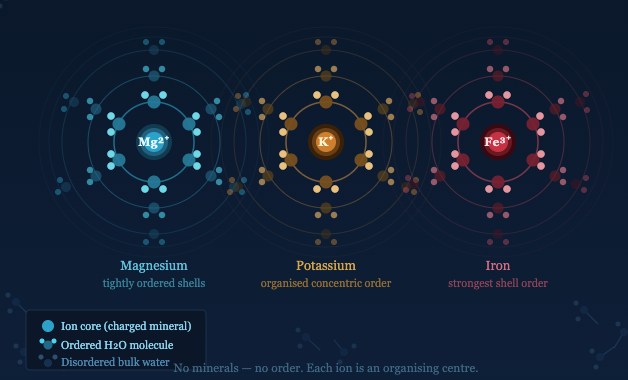
At surfaces — interfacial water A second level of organisation appears wherever water meets a surface — cell membranes, mineral lattices, proteins. Near these charged or polar surfaces, water molecules adopt preferred orientations and slow their motion. This is well-established spectroscopy: water adjacent to mineral surfaces such as biotite mica becomes measurably more ordered than bulk water. Like a Tokyo subway platform at rush hour — the first row is highly organised, the second influenced, and further back, chaos resumes. Classical surface chemistry says this ordering extends only a few nanometres — roughly ten molecular layers. Beyond that distance, the controversy begins.
Gerald Pollack and the exclusion zone — the fourth phaseProfessor Gerald Pollack at the University of Washington built on a century of scientists — including Nobel laureate Albert Szent-Györgyi and biophysicist Gilbert Ling — who proposed that water in biological systems behaves differently from bulk liquid. His exclusion zone experiments found that adjacent to hydrophilic surfaces, large regions formed from which particles were excluded, implying the water within had adopted a more ordered arrangement. He reported these regions extended 10,000 to 100,000 times farther than classical surface chemistry described — an extraordinary claim. He called this EZ water or the fourth phase: somewhere between liquid and solid, carrying a net negative charge while adjacent bulk water carried a positive charge, storing electrochemical potential. Infrared light expanded the zones. Healthier cells appeared to contain more of it. Toxins caused it to shrink. He proposed a characteristic UV absorption peak at 270 nanometres as its measurable signature.
The scientific community divided. Some confirmed aspects of his work; others disputed the scale. No consensus emerged — but the concept moved rapidly from laboratory to wellness culture to device marketing, spawning vortex devices, spinning carafes, magnetic wands and crystal bottles, all claiming to create EZ water with little mechanism and less evidence.
The honest position
The existence of extended water organisation beyond classical interfacial layers cannot be confidently proved — but it cannot be dismissed either. A long line of serious scientists across more than a century have proposed versions of this idea. What can be said with confidence is:
• Hydration shells are real — ionic minerals create organised, electrochemically active regions. Established chemistry.
• Interfacial water is real — water adjacent to mineral and biological surfaces is measurably more ordered. Established spectroscopy.
• Ionic mineral composition determines electrochemical state — and that state determines how water interacts with membranes, hydrates cells, and supports cellular function.
• Whether EZ water is real as Pollack describes — is unresolved. But that mineral-rich, surface-conditioned water behaves differently from stripped bulk water — that much is not contested.
The term structured water has been so thoroughly appropriated by device marketing that it no longer communicates anything precise. More accurate terms are emerging: cosmotropic water — water whose ionic mineral composition promotes molecular order — or electrically coherent water — water whose electrochemical architecture allows efficient charge and energy transfer.
The concept that matters is not a physical geometry imposed by a spinning device. It is the electrochemical state of water determined by its ionic mineral composition. That state is what biology runs on — and what modern water treatment has systematically destroyed.
UPE — The Light Your Mitochondria Emit
Every living cell in your body is emitting light. Not bioluminescence — something far subtler and more important. Ultraweak photon emission, or UPE, is the continuous photonic output of metabolic activity, and growing evidence suggests it is one of the primary mechanisms by which cells coordinate themselves faster than any chemical signalling pathway could explain. Whether that signal travels or dissolves into noise depends almost entirely on the quality of the water surrounding each cell. Before we get there, we need to answer a simpler question: what does it actually mean for water to be structured?
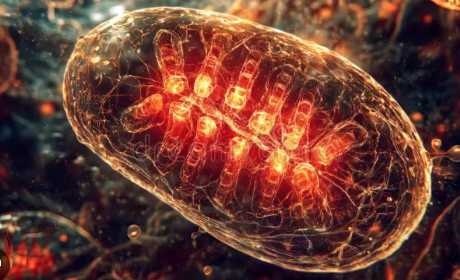
Every living organism continuously emits photons without external stimulation — bacteria, fungi, plants, human skin, blood and tissue. UPE arises primarily from the mitochondrial respiratory chain and the reactive oxygen species produced during oxidative phosphorylation. It was first described by Alexander Gurwitsch in 1923, but detection technology working at intensities of a few hundred photons per second per square centimetre — ten million times weaker than anything the human eye perceives — only matured in recent decades.
Research groups including those of Fritz-Albert Popp and Roland van Wijk have shown that biophotonic emission carries coherent properties — information transmission rather than metabolic waste. UPE fluctuations correlate with alpha wave production in the brain. Stressed mitochondria in one isolated chamber alter the respiration of mitochondria in a chemically separate adjacent chamber — most consistent with photonic rather than chemical transmission.
Because UPE arises from mitochondrial oxidative phosphorylation, its intensity and coherence are direct readouts of mitochondrial health. Blood UPE intensity in diabetic patients is three to four times higher than in healthy subjects; hyperlipidaemic patients show similarly elevated emission; cancer tissue shows measurably different UPE patterns from healthy tissue. The model: a healthy mitochondrion in a coherent medium produces UPE that is low in intensity but high in coherence — a quiet, organised signal. A stressed mitochondrion in a chaotic medium produces high-intensity, low-coherence photonic noise that cannot propagate through disorganised intercellular fluid regardless of how much energy generates it.
How Modern Life Has Collapsed the Medium
The water human biology evolved drinking had spent decades in mineral-rich geological environments acquiring through prolonged contact with volcanic rock a broad, balanced, ionically coordinated architecture. Modern treatment removes most of that.
- Reverse osmosis strips 90–99% of dissolved solids.
- Chlorination disrupts electrochemical balance.
- Pipe transit eliminates remaining mineral organisation. What reaches your cells is ionically impoverished and electrochemically chaotic.
The measurable biochemical consequences — increased diuresis, accelerated renal mineral loss, destabilised plasma osmolality — capture only the visible surface. The deeper consequence is the degradation of the photonic communication system UPE depends on. As intercellular water loses ionic coherence, biophotonic signals degrade into noise before reaching adjacent cells. Coordination slows. Repair is delayed. The body compensates through cruder, slower, more inflammatory chemical pathways — and over years this manifests as the diffuse systemic decline that characterises modern chronic illness.
It is not only that we are starved of minerals and burdened with contaminants. It is that the medium through which our cells communicate has quietly collapsed — and we have been treating the downstream symptoms without addressing the upstream cause.
Chemical Coherence vs Physical Structuring
Vortex devices, magnetic field units, spinning carafes, crystal-infused containers — the market of products claiming to create structured or coherent water is large and growing. Understanding why Aurmina™ is categorically different requires understanding what biological water coherence actually is.
Physical structuring methods impose a temporary arrangement on water molecules without changing the underlying ionic chemistry. The moment the physical force dissipates — typically seconds to minutes — the arrangement relaxes back to the thermodynamic baseline of the water’s actual ionic content. If that content is ionically depleted tap water, it returns to ionically depleted tap water. No ions have been added. No contaminants removed. Redox potential unchanged. Electrochemical architecture unrestored.
More fundamentally: physical devices cannot create hydration shells, because hydration shells require ionic minerals and physical devices add none. They cannot create interfacial order at biological surfaces, because that order is a function of the ionic mineral composition meeting those surfaces.
You cannot spin your way to ionic mineral balance. Physical energy changes the shape of water molecules temporarily. Ionic minerals change the chemistry permanently. It is the chemistry that determines biological coherence.
The coherence that matters biologically — allowing UPE to propagate through intercellular fluid, hydrating cells electrochemically rather than merely volumetrically — is electrochemical in origin. It emerges from a balanced, broad-spectrum array of ionic minerals in the precise relationships that prolonged geological mineral-water interaction produces: the ISAW system — iron, sulfur, aluminium, water — operating in biotite and vermiculite environments. This electrochemical coherence does not dissipate in seconds. It is a property of the water’s chemistry, not of any physical force. It persists as long as the ionic mineral composition remains intact — which is why water that has spent centuries in volcanic mineral contact retains its biological properties, and why the healing springs of antiquity worked regardless of whether anyone was vortexing them.
Physical structuring is a temporary mechanical intervention. Chemical coherence is a sustained electrochemical state. Aurmina™ produces the latter — the only kind that biology actually runs on.
How Aurmina™ Restores the Medium
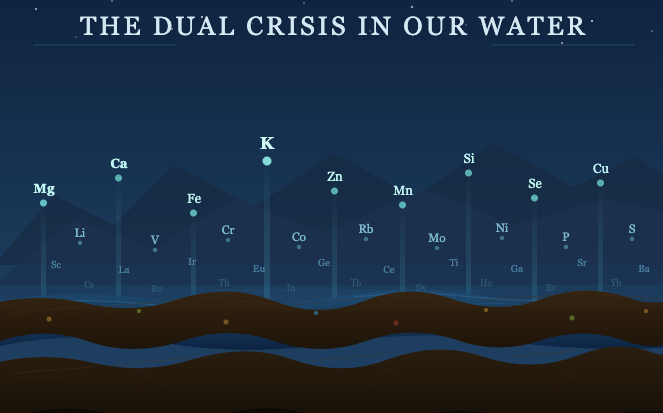
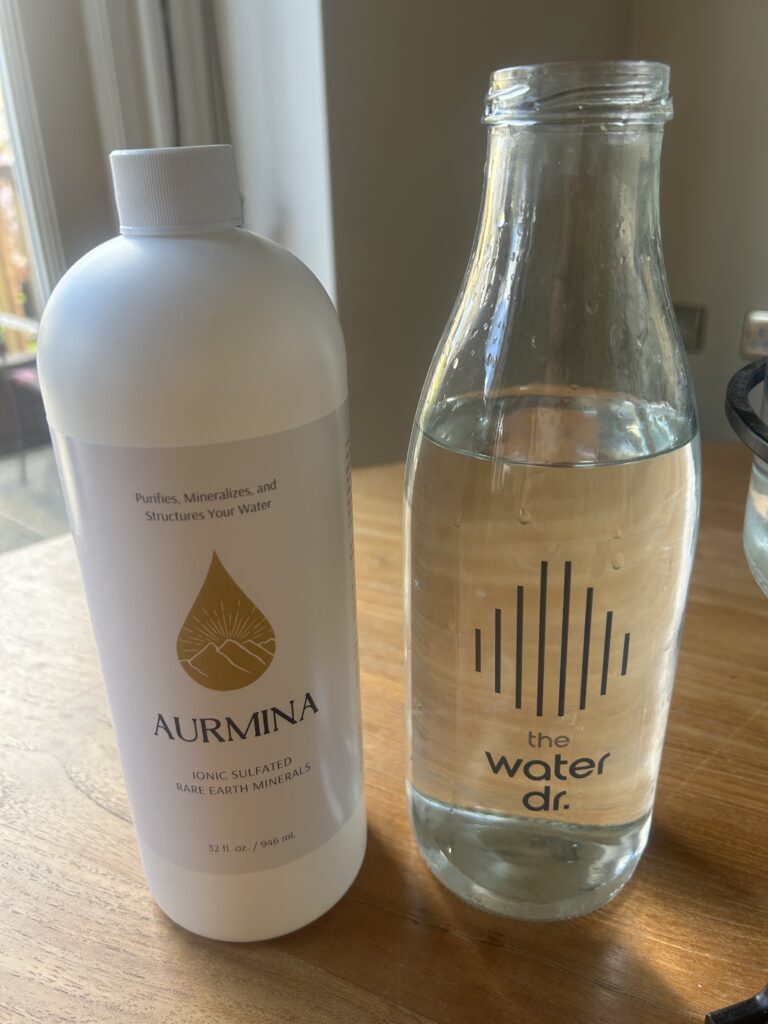
Aurmina’s™ ionic sulfated mineral complex restores the electrochemical conditions under which water becomes biologically coherent by its own chemistry — the same way prolonged volcanic mineral contact produces coherent water geologically. The mechanism operates on four fronts simultaneously: iron ions drive flocculation, clustering and precipitating contaminants; sulfate ions form insoluble compounds with heavy metal cations removing them from solution; the aluminosilicate matrix provides the organised charged scaffold for stable ionic distributions; and the full spectrum of trace minerals — iron at 792 mg/l, sulfur at 5,800 mg/l, through magnesium, potassium, calcium, manganese, zinc and 70+ others — restores the broad ionic architecture that coherent biological water has always carried.
The result is water whose redox potential normalises, electrical conductivity improves, pH stabilises, and ionic profile shifts from the narrow, bicarbonate-depleted state of modern treated water toward the broad-spectrum, sulfated profile of water conditioned by geological mineral contact. Because this is a chemical change, not a physical one, it persists. Natural healing springs worked for millennia precisely because geological ISAW chemistry had already done what no device can replicate.
It was never magic. It was always chemistry.
What Restoring the Medium Means for the Body
When the medium is coherent, cellular photonic coordination functions as it evolved to — rapid oxidative stress response, coordinated tissue repair, efficient mitochondrial signalling. When it collapses, as it has progressively for the modern human body, these functions degrade steadily across years in the same diffuse pattern that characterises modern chronic disease.
Aurmina™ does not claim to treat any of these conditions. What it does — and what the science supports — is restore the electrochemical medium: remove what does not belong, return what does, and give water back the ionic mineral complexity and redox coherence it carried when human biology evolved drinking it.
The cells know what to do with coherent water. They have known for four billion years. The question is simply whether we give them the medium they were designed to work with
Pierre Kory’s Medical Musings — pierrekorymedicalmusings.com please visit for a far better explanation of what I have tried to consolidate !
to learn more or for further questions please reach out and book free consultation ..

About the Author
Nick Smith | Founder | The Water Dr. & Cellthyhomes
Nick has dedicated years to studying building biology, healthy living environments, and the impact of environmental toxins on inflammation.
Whilst regulations for UK drinking water are slow to adapt, & influenced by conflicts of interest, Nick conduct comprehensive research on global regulations & scientific literature to offer water filtration solutions that provide clean drinking water free from all harmful contaminants.