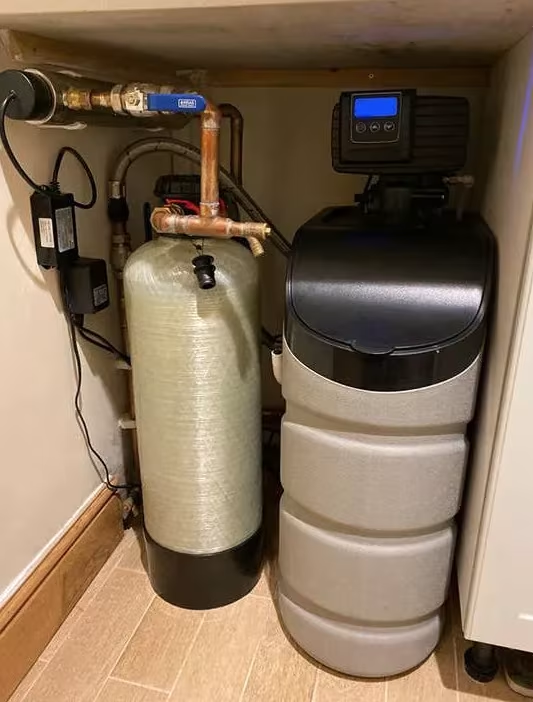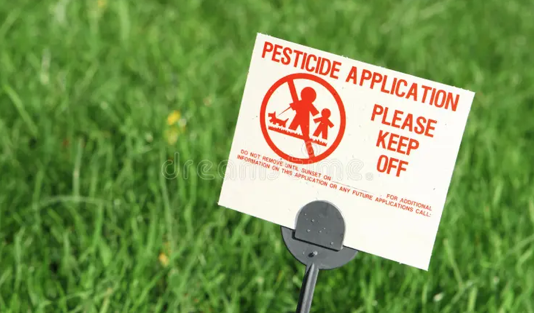
Only 0.1% of pesticides effectively reach their target organisms — the remainder contaminates the surrounding environment, with residues detectable in soil, water, air, food, crops, and human blood.
A national review of the gap between what is used, what is tested, who decides, what treatment can actually remove — and what the science says about the risks. Incorporating the first published EIR response from Bristol Water as a case study in what the data actually looks like when you ask
The UK government reports 99.997% compliance with pesticide standards in drinking water. That sounds like a near-perfect record. But it is compliance with a standard set in 1980 — before modern analytical chemistry , before the metabolite contamination problem was understood, and before the cancer evidence we now have existed. This review examines what is behind that number, who controls it, what it misses, and what it would cost to fix.

Part 1 — The Standard: What 99.997% Compliance Actually Mean
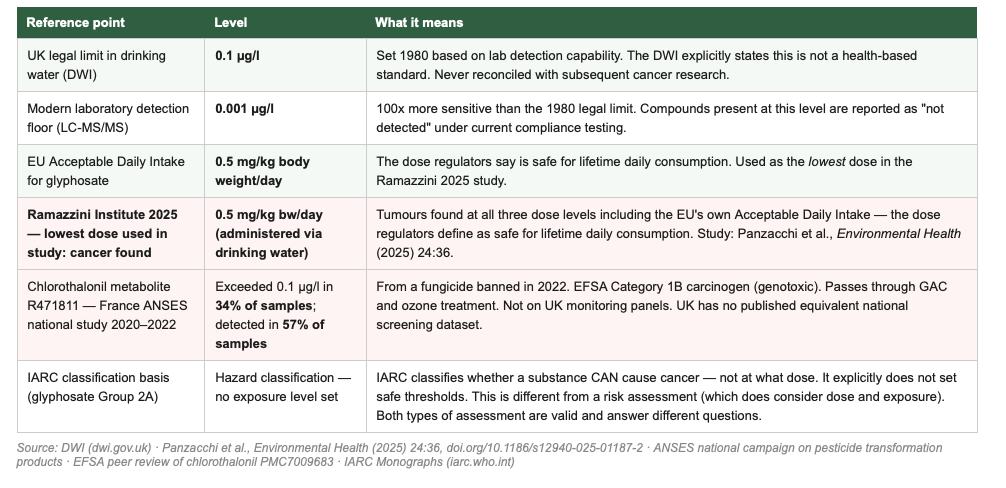
Every litre of drinking water in England and Wales must contain no more than 0.1 micrograms per litre (μg/l) of any individual pesticide, and no more than 0.5 μg/l total across all detected pesticides combined .These limits are in the Water Supply (Water Quality) Regulations 2016. Neither number was derived from health science.
“It is not a health-based standard; it is based on the limit set by the European Commission in 1980 to reflect the limit of. analytical methodology at the time and as an environmental policy to generally limit pesticides.” dwi.gov.u
The 0.1 μg/l figure was chosen in 1980 because that was the lowest level the best laboratory instruments of the day could reliably detect. It was a technology floor, not a safety threshold. It has never been updated in 46years. Modern LC-MS/MS instruments can now detect pesticides at 0.001 μg/l — 100 times more sensitive.This means compounds that would have been reported as ‘not detected’ in 1980 are now routinely found in research samples, but compliance labs calibrated to the old standard still report them as absent . Compliance is also measured at the consumer’s tap after full treatment — not at source. A river or aquifer carrying pesticides far above 0.1 μg/l triggers no legal breach, provided enough is removed before it reaches your kitchen. There is no regulation on safe levels of pre-treatment raw water.
Part 2 — 266 Authorised Substances, ~50–80 Tested: The Monitoring Gap
There are 266 active pesticide substances currently authorised for agricultural use in Great Britain. There is no single national list of which ones must be tested in drinking water. Each of the 25 water companies builds its own monitoring list from a catchment risk assessment. On average, each company tests for approximately 50 to 80 substances.

Just ” SOME ” of the gaps with our current oversight , regulation and risks ……
- The water company’s scientists review abstraction data, catchment surveys, agronomist reports, and Environment Agency data to identify which pesticides are likely to reach raw water. This is the right principle — but it means the list is built on what the company already knows to look for.
- HSE approves a new pesticide for agricultural use. There is no automatic trigger requiring any water company to add it to its monitoring schedule. The approval-to-monitoring pathway does not exist as a formal mechanism.
- The drop-off rule: if three consecutive years of tests show concentrations below 30% of the 0.1 μg/l limit , the DWI does not require continued testing. Absence of detection becomes partly a product of a decision to stop looking — even if farming practice in the catchment has since changed.
- Metabolites are outside the system , They tend to be more water-soluble, meaning they move more easily through soil into groundwater. They are frequently more persistent — lasting years or decades after the parent compound has disappeared. And they can be more toxic, as the chlorothalonil case demonstrated — the metabolite R471811 was classified as more dangerous than chlorothalonil itself.
Part 3 — High-Risk Areas: Where the Pressure Is Greatest
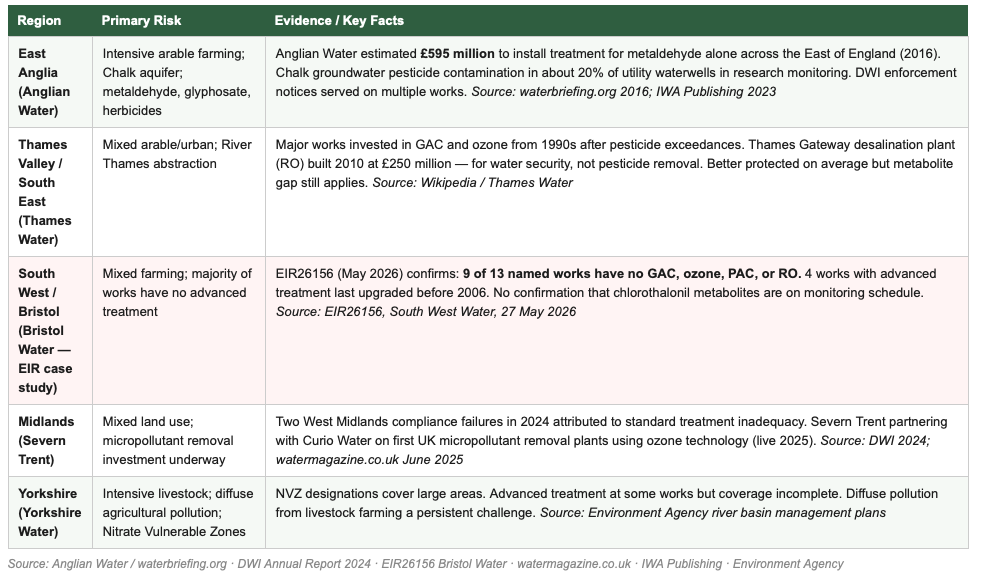
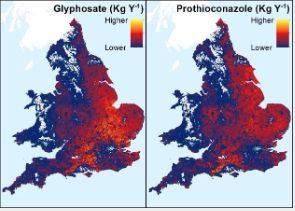
Risk is not uniform across England and Wales. The combination of intensive arable agriculture, geology that allows rapid pesticide movement into groundwater, and older treatment infrastructure creates specific hotspots. These are the areas where the gap between what is used and what is tested has the most direct consequence
Part 5 — Case Study:
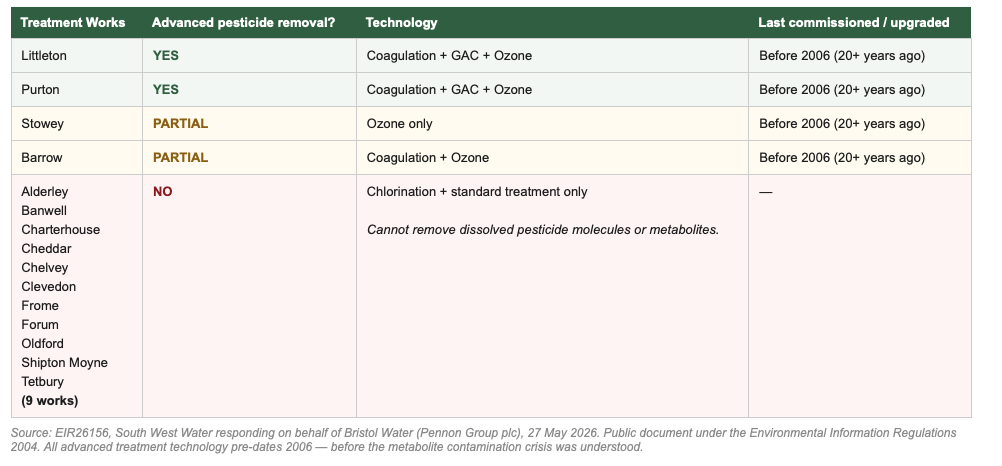
BW operates thirteen treatment works serving around 1.2 million people in the Bristol area. Of those thirteen, nine have no advanced pesticide removal technology whatsoever. That means the water leaving those works has been through chlorination and standard filtration — processes designed to deal with bacteria, sediment, and turbidity. They were never designed to remove dissolved chemical molecules, and the science is unambiguous that they cannot do so.
The remaining four works do have more advanced technology — a combination of granular activated carbon and ozone at two of them, ozone alone at a third, and coagulation plus ozone at the fourth. That sounds reassuring until you notice two things. First, as we explain elsewhere in this article, GAC and ozone are effective at removing certain types of pesticide but fail completely against the polar metabolites — the breakdown products — that represent the most serious emerging risk. Second, and perhaps most strikingly, every single one of those four upgraded works last commissioned or significantly upgraded its technology before 2006. That is over twenty years ago. The metabolite contamination problem was not understood in 2006. Chlorothalonil was not banned until 2022. The ANSES study that found its metabolites in 57% of French drinking water samples was published in 2023. The equipment treating Bristol’s water was designed and installed before any of that was known.
To be clear, this is not an attack on Bristol Water specifically. This pattern — the majority of works with no advanced treatment, the minority with technology two decades old — is consistent with what the national picture looks like. Bristol Water responded to our EIR request fully and within the legal timeframe. They are operating within the rules as they exist. The point is that the rules, the investment, and the technology have not kept pace with what the science now tells us is in the water.
Part 6 — Who Decides What Gets Tested? The Accountability Chain
Understanding why these gaps exist requires understanding who is responsible for each decision — and crucially, where the incentives point.
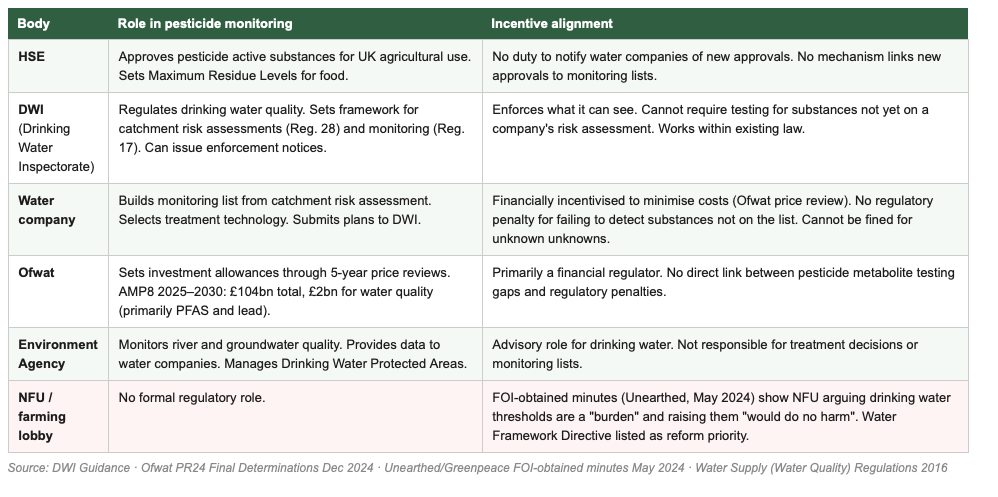
The incentive problem in plain terms – Water companies are regulated on financial efficiency by Ofwat. They are required to test what they know about, not to find what they don’t. The DWI can only enforce against known standards. HSE approves substances without triggering monitoring. The farming lobby is pushing to raise thresholds. Nobody in this system is paid to look harder for problems they haven’t yet found.
Part 7 — What Would It Cost to Fix? Who Would Pay?
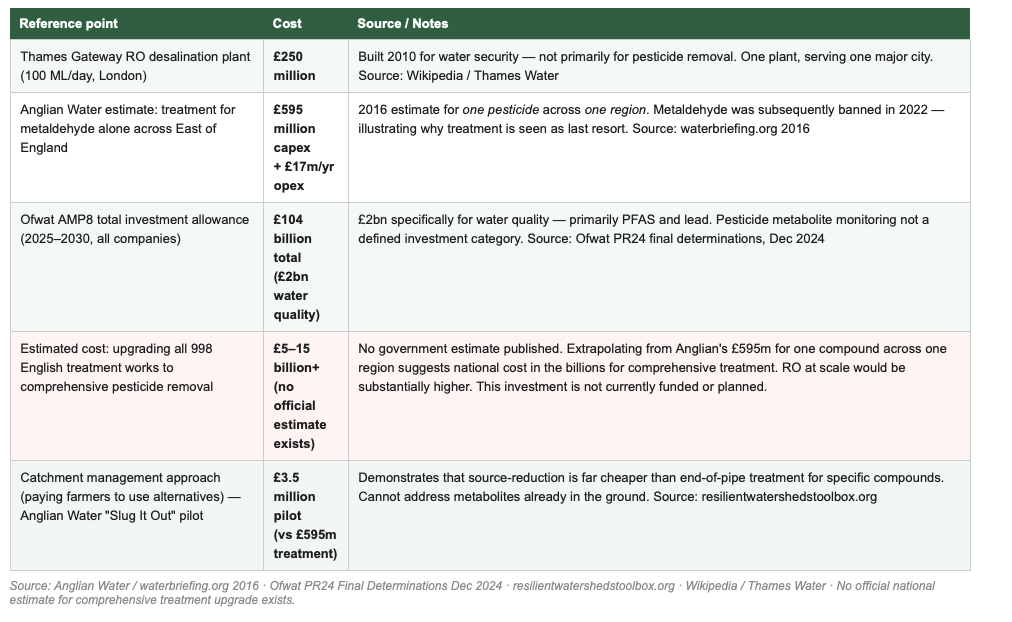
The cost of upgrading UK water treatment to provide comprehensive pesticide and metabolite removal is substantial — and the numbers that exist in the public domain illustrate why it is not happening.
Who would pay?
The current position is that nobody is paying for comprehensive pesticide metabolite treatment, because it is not legally required. If it were required, there are three theoretical funding sources — and each has significant problems:
- Water bills (customers): The current model. Anglian Water noted that customers ‘should not be the financial backstop for pesticide treatment’ — costs caused by agricultural use should not fall on domestic water consumers. But in practice, any treatment upgrade would be passed through in bills.
- Polluter pays (agriculture / manufacturers): The legal principle under the Water Framework Directive. In practice, enforcement against diffuse agricultural pollution is extremely difficult. Manufacturers of banned substances cannot be pursued for legacy metabolites in groundwater.
- Government / public subsidy: The £104bn AMP8 programme includes very little specifically for pesticide metabolite treatment. No government programme currently funds comprehensive treatment upgrades for this purpose
Part 8 — The Cancer Evidence and the Dose Question
The relationship between pesticide exposure and cancer is among the most studied areas of environmental health. Understanding it properly requires distinguishing between two different types of scientific assessment that are frequently confused in public debate.
IARC: hazard classification — not risk assessment
IARC (International Agency for Research on Cancer, WHO) classifies substances by whether they arecapable of causing cancer — the hazard. IARC explicitly states it does not assess exposure levels and does not set safe thresholds. Its classification covers a substance under any conditions, not at typical drinking water concentrations. This is why glyphosate (Group 2A: probably carcinogenic) can simultaneously be classified as a hazard by IAR
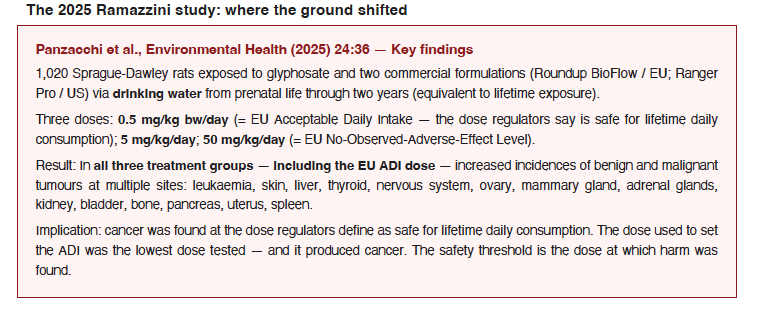
How the dose levels compare to drinking water concentrations The Ramazzini study used doses measured in milligrams per kilogram of body weight per day (mg/kg/day) —the unit regulators use for safe intake assessments. Drinking water concentrations are measured in micrograms per litre (μg/l). These are different units describing different parts of the exposure picture. The key comparison is this: the 1980 legal limit of 0.1 μg/l was never set by reference to the doses used in cancer studies. It was set by lab capability. No reconciliation between the 0.1 μg/l limit and cancer research has ever been done.
Glyphosate, Cancer and the $11 Billion Question
Glyphosate is the world’s most-used herbicide — the active ingredient in Roundup, sold in every garden centre. According to PAN UK’s analysis of official UK government data (April 2026), application on UK farmland has risen more than 1,000% since 1990, with over 2.6 million hectares treated in 2024 — sixteen times the size of Greater London.
In the US, hundreds of thousands of people who used Roundup — primarily agricultural workers — developed non-Hodgkin lymphoma and sued. Bayer, which owns Roundup, has paid out more than $11 billion in settlements without ever formally admitting the product causes cancer. Litigation continues.
IARC classified glyphosate as Group 2A — probably carcinogenic to humans — in 2015. In 2025, the Ramazzini Institute administered it to rats via drinking water at doses equivalent to the EU’s own acceptable daily intake — the amount regulators define as safe for lifetime daily consumption — and found tumours across multiple sites at every dose level tested. In France, the government has been paying compensation to farmers with Parkinson’s disease linked to glyphosate exposure since 2021 — one of the first formal government acknowledgements of a direct causal link between a pesticide and a specific disease.
Glyphosate remains fully approved in the UK. Its use is growing. The legal limit in drinking water — 0.1 µg/l — was set in 1980 and has never been reviewed in light of any of this evidence.
Organophosphates: The Insecticide Class With a Military History
While much of the cancer debate has focused on glyphosate, there is a second major class of pesticides in UK agricultural use that receives far less public attention: organophosphate pesticides, or OPPs. These are primarily insecticides — compounds designed to kill insects by attacking their nervous systems. They include chlorpyrifos, malathion, diazinon, dichlorvos, and parathion, and they are among the most widely detected pesticides in European surface water and groundwater.
What most people do not know is where organophosphates come from. They were originally developed as chemical warfare agents. Tabun, sarin, soman, and cyclosarin — nerve agents banned under international law — are all organophosphates. The agricultural versions work by exactly the same biological mechanism: they block acetylcholinesterase, the enzyme that allows nerve signals to switch off. Without it, the nervous system cannot stop firing. In high doses this causes convulsions and death. In chronic low doses — the kind relevant to drinking water exposure over a lifetime — the long-term effects on the human nervous system are, in the words of a 2025 Royal Society of Chemistry peer-reviewed review, insufficiently studied.
A landmark statistic from the same review puts the broader problem in context: only 0.1% of pesticides applied to crops effectively reach their target organism. The remaining 99.9% enters the surrounding environment — soil, air, water, food, and ultimately human blood.
Chlorpyrifos is the most studied OPP and arguably the most concerning. It has been classified as both a neurotoxin and a human carcinogen by the US National Cancer Institute, with research suggesting a link to lung cancer among applicators. The EU banned it for food use in 2020. The US followed in 2021. In the UK it has faced restrictions but the picture on residual use and monitoring in catchment water is not fully transparent. Critically, like chlorothalonil, it has metabolites — breakdown products — that are more mobile in water than the parent compound and whose long-term toxicity profile is not fully understood.
The research gap the RSC review explicitly identifies is the same gap running through this entire investigation: there is insufficient longitudinal data on chronic low-dose exposure to organophosphates, including neurobehavioural effects and developmental disorders in children. The science has simply not been done at the concentrations found in drinking water over a lifetime. That is not evidence of safety. It is evidence of a gap.

And finally ( SORRY ) -The regulatory framework for bottled water in the UK is exactly the same ..
The legal pesticide limit for natural mineral water is exactly the same as for tap water: 0.1 µg/l per individual substance and 0.5 µg/l total. This limit was confirmed in the Natural Mineral Water, Spring Water and Bottled Drinking Water (Amendment) (England) Regulations 2003 and remains in force.
The regulations state that only those pesticides likely to be present in a given water need to be monitored. That is the same principle — and the same gap — as with tap water. The producer decides what to test for based on their assessment of what is likely to be there. There is no national list of which substances must be tested. There is no independent body conducting comprehensive screening. The monitoring is done by the producer and submitted to local authorities — not to the DWI, which only regulates public mains supplies.
Natural mineral water is not treated. That means there is no GAC, no ozone, no chlorination standing between whatever is in the aquifer and what reaches the bottle. For pristine deep aquifers with genuinely protected catchments that may be fine. For aquifers in or near agricultural areas — which describes a significant proportion of UK underground water sources — it means the water’s quality is entirely dependent on catchment geology and land use, with no treatment backstop whatsoever.
Private boreholes in agricultural areas face the least scrutiny of any category of drinking water in England, with local authority oversight that varies significantly in scope and frequency, and no national requirement to test for the compounds that the science now identifies as the most concerning.
Conclusion — Five Compounding Gap
1. The standard is not health-based
0.1 μg/l was set by 1980 lab capability. It has never been reconciled with cancer research, metabolite toxicology, or mixture effects. The DWI says so explicitly.
2. We only test for a fraction of what is used
266 authorised substances; 50–80 tested per company. No national list. No automatic mechanism linking new approvals to monitoring. Drop-off rule allows substances to leave monitoring as farming practice changes.
3. Metabolites are the blind spot
The breakdown products of banned pesticides — many more toxic, more persistent, and more water-soluble than the parent — are largely outside the monitoring system. They defeat the GAC and ozone treatment that does exist. Only RO removes them reliably.
4. Treatment infrastructure is static, underfunded, and incomplete
Bristol Water’s EIR response confirms 9 of 13 works have no advanced treatment. The 4 that do last upgraded before 2006. Comprehensive national upgrade would cost billions. Nobody is currently funding it. Ofwat’s £104bn AMP8 programme allocates £2bn to water quality — primarily PFAS and lead, not metabolites.
5. The political direction is the wrong way
Post-Brexit approval extensions without scrutiny. NFU lobbying to raise thresholds. UK Priority Substance list frozen since 2018. EU tightening. DWI recommendations on lead and PFAS unimplemented. The Ramazzini 2025 study finding cancer at the EU’s own acceptable daily intake has not triggered a regulatory response.
The good news is we have assimilated the data for a FREE REPORT for specific risks at your address not just pesticides but all contaminants levels and gap analysis … all you have to do is get in touch BOOK HERE for the report and we can guide you through all the many remediation options that are available … We are independent consultants so we are outcome orientated and not manufacturer biased …
Please reach out we are here to help .



About the Author
Nick Smith | Founder | The Water Dr. & Cellthyhomes
Nick has dedicated years to studying building biology, healthy living environments, and the impact of environmental toxins on inflammation.
Whilst regulations for UK drinking water are slow to adapt, & influenced by conflicts of interest, Nick conduct comprehensive research on global regulations & scientific literature to offer water filtration solutions that provide clean drinking water free from all harmful contaminants.