Water Fluoridation: Is the Benefit Worth the Risk?
Water fluoridation risks deserve closer attention. Adding fluoride to drinking water can help reduce tooth decay, but does that benefit justify increasing fluoride exposure across an entire population, including pregnant women and young children?
And what do we know about the possible long-term effects of adding fluorosilicic acid to public water supplies?
If the extra reduction in tooth decay is relatively modest, while questions remain about possible effects on brain development and other aspects of health, is fluoridating everyone’s water the right approach? Could we do more through fluoride toothpaste, better access to NHS dentistry and targeted prevention, without adding fluoride to the public water supply?
This article looks at the evidence for the dental benefits, the concerns about potential health risks, and what the research can—and cannot—tell us about fluoridation at UK levels.
1. What are the dental benefits?
Fluoride helps protect teeth against decay. It strengthens enamel and supports remineralisation, particularly when applied directly to the teeth.
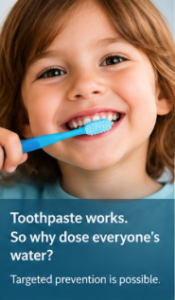 But how much additional protection comes from fluoridated drinking water in modern populations where fluoride toothpaste is widely used and easily / cheaply accessed .
The 2024 Cochrane review examined studies of community water fluoridation and found that evidence from more contemporary studies suggested a smaller improvement in children’s tooth decay than was reported in older research. The certainty of this evidence was limited.
Source: Cochrane review — Water fluoridation for prevention of dental caries (2024)
England’s 2026 health-monitoring report also found less tooth decay among children living in fluoridated areas, with benefits particularly apparent in more deprived communities. However, observational comparisons cannot establish that every difference is caused by fluoridation alone.
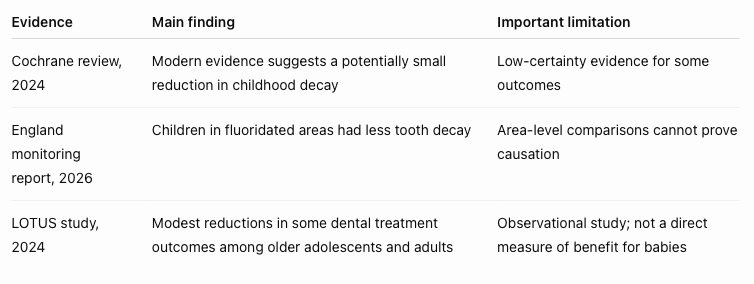
Sources: Cochrane, England report, LOTUS study.
These findings support the ” possibility ” of a dental benefit. They do not automatically settle whether universal fluoridation is the best way to achieve it.
2. We already have fluoride toothpaste — so why add it to everyone’s water?
Fluoride toothpaste delivers fluoride directly to the teeth, where it helps protect enamel. This makes it an important part of routine dental prevention.Unlike fluoridated water, toothpaste can be used as a targeted intervention. People can brush their teeth without requiring fluoride to be added to the drinking water supply for everyone.
The NHS recommends brushing twice daily with fluoride toothpaste and supervising young children to minimise swallowing. The US has more specific warnings in case of swallowing which begs more questions .
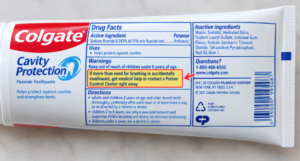
Sources: NHS — How to keep your teeth clean, NHS — Taking care of children’s teeth, UK fluoride guidance.
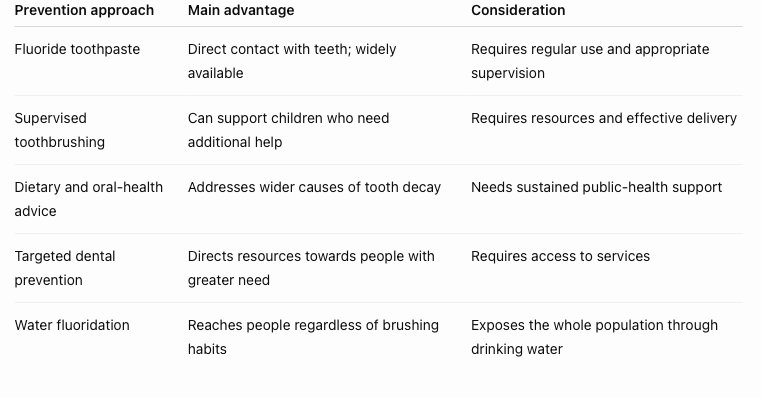
The strongest argument for fluoridation is that it does not depend on individual behaviour and may help reduce inequalities. That is an important consideration, especially for children who have limited access to dental care.
But the existence of a benefit does not mean it is the only available approach and why is this chosen rather than improving access to toothpaste, supervised brushing and preventive dental care could deliver substantial benefits with greater individual choice.
Sources: NHS oral-health guidance, supervised toothbrushing programme toolkit.
3. The risks: why early-life exposure deserves particular attention
The key health question is not simply whether fluoride can prevent tooth decay. It is whether repeated exposure through drinking water is justified for everyone, including people who may be more susceptible to its effects.
The Fluoride Action Network (FAN) identifies several areas of concern: neurodevelopment, thyroid function, bone health, dental fluorosis and potential differences in susceptibility between individuals. FAN argues that these concerns warrant ending water fluoridation. Its interpretation is strongly precautionary, so individual claims should be assessed against the underlying studies and independent scientific reviews.
Sources: FAN — Health Effects of Fluoride, FAN — Vulnerable Populations.
Brain development and IQ
The concern with neurodevelopment is particularly important because pregnancy and early childhood are critical periods of brain development.
The US National Toxicology Program’s 2024 systematic review concluded, with moderate confidence, that higher fluoride exposure—particularly levels exceeding 1.5 mg/L in drinking water—was associated with lower IQ in children. However, it found insufficient evidence to determine whether exposure at 0.7 mg/L, the US recommended fluoridation concentration, affects IQ.
Some observational studies have reported associations between maternal fluoride exposure and children’s cognitive scores. These findings raise questions, but differences in exposure, study design and potential confounding mean that they do not prove that community fluoridation at typical UK concentrations causes IQ loss.
Sources: National Toxicology Program review, Green et al., 2019, three-cohort study.
England’s 2026 health-monitoring report found no association between fluoride exposure measures and cognitive test scores in children aged five and seven. This is reassuring, although the study relied on geographical exposure estimates rather than detailed individual exposure histories.
Source: England Water Fluoridation Health Monitoring Report, 2026.
The policy concern remains: uncertainty about a possible developmental effect matters when exposure is population-wide and the intervention is intended to provide a dental benefit that modern studies suggest may be modest.
Who might be more vulnerable?
FAN highlights several groups it believes deserve particular consideration. The strength of evidence differs between these groups, and susceptibility should not automatically be interpreted as proof that ordinary fluoridated water harms them.
| Group or concern | Why it deserves attention | What the evidence supports |
|---|---|---|
| Pregnant women and developing babies | Prenatal exposure coincides with a critical period of brain development | Some observational studies report associations with child IQ; causation at typical UK exposure levels is not established |
| Infants, particularly those fed formula | Water can contribute substantially to total intake relative to body weight | Total intake depends on water concentration, feeding practices and other sources; excessive ingestion during tooth development can increase fluorosis risk |
| Young children | They may swallow toothpaste and have a higher intake relative to body weight | Dental fluorosis is an established dose-related risk of excessive fluoride ingestion while teeth develop |
| People with impaired kidney function | The kidneys are important in fluoride excretion | Reduced kidney function may alter fluoride handling; the magnitude of risk at community-water concentrations requires careful assessment |
| People with nutritional deficiencies | FAN highlights calcium and iodine status as potential modifying factors | The extent to which nutritional status changes risk at typical UK exposure levels is not fully established |
| People reporting fluoride sensitivity | FAN describes reports of skin and other symptoms attributed to fluoride | Reports exist, but the frequency and causal relationship with low-level community exposure remain uncertain |
Source for FAN’s position: Vulnerable Populations. For the wider neurodevelopment evidence, see the NTP review.
The issue is not that every person in these groups will be harmed. It is that a single population-wide concentration may not account equally well for every person’s circumstances, total intake or susceptibility.
Dental fluorosis and total exposure
Dental fluorosis is an established effect of excessive fluoride ingestion while teeth are forming. It can appear as faint white marks or, in more severe cases, staining and pitting of enamel. Risk depends on the amount consumed, the duration of exposure and the stage of tooth development.
Fluoride exposure does not come from drinking water alone. It may also come from food and drinks prepared with that water, swallowed toothpaste and other fluoride-containing dental products.
That makes total exposure important, particularly in young children. It also reinforces the need to distinguish between fluoride applied to teeth as directed and fluoride that is swallowed.
Source: NHS guidance on children’s teeth.
Thyroid, bones and other proposed effects
FAN also raises concerns about thyroid function, skeletal health, kidney effects, gastrointestinal symptoms, immune effects and cancer.
These outcomes should not be treated as equally established. Skeletal fluorosis is associated with prolonged high exposure, and dental fluorosis is a recognised consequence of excessive ingestion during tooth development. For thyroid effects, cancer and many other proposed outcomes, findings vary by outcome and exposure level; evidence at typical community-fluoridation concentrations is limited or inconsistent.
The European Food Safety Authority’s 2025 assessment examined fluoride intake from drinking water, food and swallowed dental products, with particular attention to neurodevelopment, thyroid function and bone health. It found that the evidence for developmental effects was more consistent at higher exposures, while uncertainty remained at lower exposures.
Source: EFSA — Updated fluoride safety assessment.
A balanced article should not imply that all the effects listed by FAN have been proved to occur at UK fluoridation levels. But neither should uncertainty be mistaken for proof that every possible risk has been excluded.
4. The precautionary question: how much uncertainty is acceptable?
The strongest case for water fluoridation is that it reaches people regardless of whether they brush regularly, can afford dental products or have easy access to dental care. England’s 2026 report found lower childhood tooth decay in fluoridated areas, with the largest benefits among children living in more deprived areas.
The counterargument is that universal exposure is not the only way to improve dental health. Fluoride toothpaste, supervised brushing, dietary support and accessible dental services can target prevention more directly.
The question is therefore one of proportionality. If the additional benefit of fluoridating water is modest in a population already using fluoride toothpaste, how much uncertainty about long-term developmental effects should society accept?
There is no scientific basis for claiming that every baby exposed to fluoridated water will experience IQ loss. But there is also a legitimate policy question about whether the evidence is sufficiently complete to justify blanket exposure when the intervention is not individually chosen.
A precautionary approach would prioritise better research into pregnancy and early-life exposure, transparent monitoring, and effective alternatives for preventing tooth decay—especially for children who currently face the greatest dental disadvantage.
The aim should be to protect both dental health and healthy development, without overstating either the benefits or the risks.
5. Does the evidence apply to UK drinking water?
Exposure matters. A study involving naturally high-fluoride water cannot automatically be applied to a UK area with a lower concentration.
The dose from drinking water depends on both concentration and consumption.
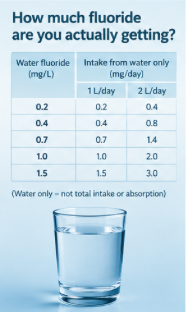
These figures show intake from water only, not total exposure or the amount absorbed by the body. Other sources may include food, drinks and swallowed toothpaste.
England’s 2026 monitoring report found that fluoride concentrations varied across areas, with most of the population in the areas examined exposed to concentrations below 0.40 mg/L. The report also found lower childhood tooth decay in fluoridated areas and no relationship with cognitive test scores at ages five and seven.
This evidence should be taken seriously. It makes it inappropriate to claim that current UK fluoridation has been shown to reduce children’s IQ. However, ecological monitoring cannot answer every individual-level question, and the absence of a detected relationship does not exclude every possible effect.
The appropriate conclusion is neither panic nor complacency. It is that decisions should reflect both the evidence of benefit and the limits of the evidence about risk.
Source: Water fluoridation: health monitoring report for England, 2026.
6. Fluorosilicic acid: the industrial chemical and the fluoride in water
Fluorosilicic acid is used in some water-fluoridation systems. In concentrated form, it is a corrosive industrial chemical that can cause severe skin burns and eye damage.
That hazard is real, but it is important to distinguish the concentrated chemical handled at a treatment plant from the much more dilute fluoride exposure in treated drinking water. Adding a hazardous concentrated chemical to a treatment process does not, by itself, prove that the resulting water is harmful.

Fluoride is the relevant ion when discussing exposure in drinking water. Fluoride is not generally recognised as an essential nutrient that humans must obtain to survive, although it has a well-established role in preventing tooth decay when used appropriately.
Fluoridation chemicals can be recovered from industrial processes, including the manufacture of phosphate fertilisers. Their industrial origin raises legitimate questions about sourcing, purity, impurities, procurement and oversight, but does not independently establish that they are unsafe at the concentrations used in drinking water.
Sources: Fluorosilicic acid safety data sheet, England monitoring report.
The key questions are what is added, in what quantity, to what standard, with what monitoring, and with what evidence of net public-health benefit.
7. What does the LOTUS study tell us about money?
The LOTUS study examined the effectiveness and cost-effectiveness of water fluoridation among people aged 12 and over in England. It used NHS data covering the period 2010–2020.
Its results suggest that fluoridation was associated with modest reductions in some dental treatment outcomes and lower NHS dental treatment costs.
| LOTUS finding | Reported result |
|---|---|
| Invasive dental treatments | Approximately 3% fewer |
| Decayed, missing and filled teeth measure | Approximately 2% lower |
| Missing teeth | No difference detected |
| Fluoridation cost per person over ten years | £10.30 |
| Lower NHS treatment costs per person | £22.26 |
| Lower patient NHS dental charges per person | £7.64 |
The £10.30 figure excludes original setup costs. These estimates relate to the study population and period and should not be treated as guaranteed savings for every individual or every scheme.
Source: LOTUS study, 2024; PubMed record; full NIHR report.
The study did not calculate a cost per IQ point lost, nor does it establish that IQ loss occurs at fluoridation concentrations. It would therefore be misleading to put a monetary figure on a hypothetical IQ effect and compare it directly with the dental savings.
Nevertheless, the economic analysis does not end the policy debate. It measures selected dental and financial outcomes; it does not resolve every uncertainty about long-term health effects or whether alternative prevention strategies would provide better value.
8. Can water filters remove fluoride?
If you’re concerned about fluoride in your drinking water, home filtration may be an option worth exploring. However, not all water filters are designed to remove fluoride, and choosing the right system depends on the technology, your water supply and your needs.
Common filtration options include:
- Activated-carbon filters and filter jugs
- Reverse osmosis systems
- Distillation systems
- Specialist fluoride-reduction filters
So how do you know which system is right for you?
Rather than guessing, get advice before spending money on a filter. Check the manufacturer’s performance data and make sure any system you consider is suitable for your requirements.
Find out more — book your FREE consultation
Want to understand your options for reducing fluoride in your drinking water? Contact The Water Dr to discuss water filtration and find out which systems may be suitable for your home.
Book your FREE consultation with The Water Dr
This is a commercial service, not an independent scientific endorsement. Check a filter’s independently verified performance, maintenance requirements and ongoing costs before purchasing.
9. What should public-health policy do?
The debate should not be reduced to “fluoride is good” or “fluoride is bad”. The real question is whether universal fluoridation is the most proportionate way to prevent tooth decay when other approaches are available.
A responsible policy should:
- Measure benefits realistically. Modern evidence suggests the additional reduction in tooth decay may be modest in populations already using fluoride toothpaste.
- Monitor early-life exposure. Research should examine pregnancy and childhood using reliable individual exposure measurements and validated developmental assessments.
- Improve prevention access. Affordable toothpaste, supervised brushing, dietary support and accessible dental services should be central to prevention.
- Be transparent about costs and sourcing. Communities should be able to examine chemical specifications, procurement arrangements, monitoring results and scheme costs.
- Review policy as evidence develops. Both reassuring and concerning findings should inform decisions, without overstating either.
The strongest case for fluoridation is that it can reach people who might otherwise miss preventive dental care. The strongest case for reconsidering blanket exposure is that the additional benefit may be limited where toothpaste and dental prevention are already available, while some questions about developmental effects remain unresolved.
Those arguments deserve to be weighed openly.
Conclusion: is the benefit worth the risk?
The evidence supports fluoride as an effective tool for preventing tooth decay. It also suggests that the additional benefit of community water fluoridation in modern populations may be smaller than historical estimates implied.
The evidence does not prove that fluoridation at current UK concentrations lowers children’s IQ. England’s 2026 monitoring results are reassuring on cognitive test scores at ages five and seven. However, major reviews and observational studies leave questions about higher exposure and early-life neurodevelopment that warrant continued attention.
For me, this is a question of proportionality and precaution. When the benefit of universal exposure may be modest, it is reasonable to ask whether targeted prevention, good oral hygiene and better access to dental care could achieve much of the same goal while preserving individual choice.
Preventing tooth decay matters. So does protecting developing children, being honest about uncertainty and ensuring that population-wide interventions meet a high standard of evidence.
The question is not whether dental health matters. It is whether the additional benefit of adding fluoride to everyone’s water is sufficient to justify the uncertainty, when alternatives already exist.
Key references
- Cochrane: Water fluoridation for prevention of dental caries (2024)
- National Toxicology Program: Fluoride and neurodevelopment (2024)
- Green et al.: Maternal fluoride exposure and child IQ (2019)
- Three-cohort study of prenatal fluoride exposure and IQ
- Water fluoridation: health monitoring report for England (2026)
- LOTUS study: effectiveness and cost-effectiveness (2024)
- NHS: How to keep your teeth clean
- The Water Dr: Free consultation
Editorial note: This is an evidence-informed critical commentary, not a completed systematic review. The cited studies differ in design, population, exposure measurement and certainty; association should not be confused with causation.


About the Author
Nick Smith | Founder | The Water Dr. & Cellthyhomes
Nick has dedicated years to studying building biology, healthy living environments, and the impact of environmental toxins on inflammation.
Whilst regulations for UK drinking water are slow to adapt, & influenced by conflicts of interest, Nick conduct comprehensive research on global regulations & scientific literature to offer water filtration solutions that provide clean drinking water free from all harmful contaminants.