By Nick Smith, Building Biologist and independent water consultant, The Water Dr · Updated 4 November 2026
England still has no legal limit for PFAS in drinking water, a year after this article first appeared. What has changed is the evidence: new DWI rules, new research on what removes PFAS, a national PFAS Plan, and a community near Blackpool where 69% of residents tested had PFOA blood levels in a higher-risk category.
This update sets out what we know, what we don’t, and what you can do. Most UK tap water meets current guidance. The question is whether that guidance covers enough.
At a glance
- Rules: DWI guidance (March 2025) sets 0.1 µg/l for the sum of 48 named PFAS. It is guidance, not law.
- Coming: the government’s February 2026 PFAS Plan promises a consultation on a legal limit. It has not been published yet.
- Gaps: companies test for 48 PFAS out of thousands. Replacement chemicals and breakdown products are often missed.
- Cost: the industry’s research body estimates almost £20bn to upgrade treatment for PFAS. About £2bn of the current five-year plan goes to all drinking water quality work.
- Removal: UK research found reverse osmosis and nanofiltration removed over 80% of even short-chain PFAS. Carbon and ion exchange struggle with short chains.
What PFAS are and why they matter
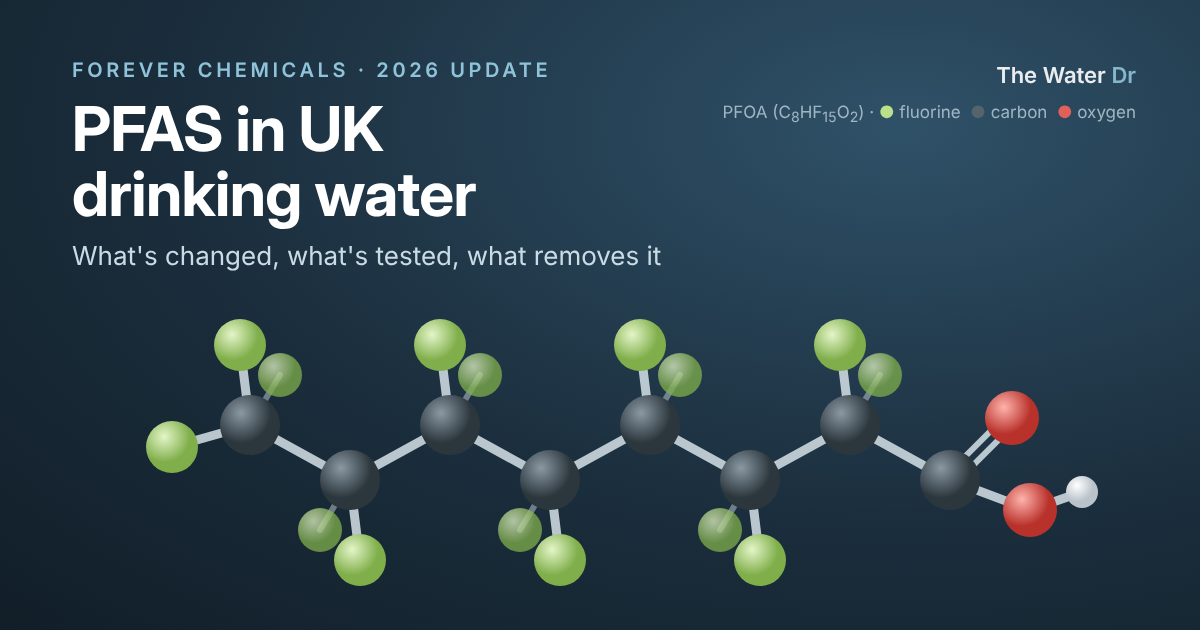
PFAS (per- and polyfluoroalkyl substances) are a family of thousands of synthetic chemicals. Their carbon–fluorine bond is one of the strongest in chemistry, so they barely break down in the environment. That is why they are called “forever chemicals”.
They have been used in non-stick coatings, waterproof clothing, food packaging and firefighting foam since the 1950s.
Long-chain vs short-chain
- Long-chain PFAS (such as PFOA and PFOS) build up in the body over years. Most of the health research is on these.
- Short-chain PFAS (such as PFBA and PFBS) were brought in as replacements. They leave the body faster, but they do not break down either. They travel further in water and are harder to remove.
What the health evidence says
The WHO’s cancer agency classifies PFOA as carcinogenic to humans (Group 1) and PFOS as possibly carcinogenic (Group 2B). Studies have linked higher exposure to raised cholesterol, kidney and testicular cancers, and thyroid and immune effects.
The evidence is strongest for higher exposures. The UK government says evidence on many individual PFAS is still being studied, and that a blood level cannot predict any one person’s health.
Where PFAS come from in the UK: three case studies
Most PFAS pollution traces back to a small number of sources: chemical manufacturing, firefighting foam, landfill and sewage sludge spread on land. Three recent cases show how it reaches people.
Thornton-Cleveleys, Lancashire: a chemical plant
The Hillhouse site, run by ICI until 1992 and now by AGC Chemicals, used PFOA from the 1950s until 2012. Council testing found PFOA in soil at 71 nearby properties, with seven homes rated “high risk”. Residents were advised not to eat fruit, vegetables or eggs grown within 1km.
In 2026, blood tests on 49 residents found 69% had PFOA levels in a category linked to increased health risk. The UK Health Security Agency had declined to offer testing; it was arranged through a legal claim. AGC says blood testing does not predict future health problems. The company is now consulting on closing the plant.
Importantly, United Utilities says in an EIR response that PFAS in tap water supplied to the area has stayed below the DWI’s lowest tier. Here, exposure appears to come through soil, food and historic emissions rather than the mains.
Bentham, North Yorkshire: a firefighting foam factory
PFAS from a foam manufacturing site has been linked to local contamination. A family’s claim was settled in 2025, and testing found around a third of residents tested had high PFAS blood levels.
Brislington Brook, Bristol: firefighting run-off
In September 2026, run-off from fighting a fire on Emery Road entered the brook, and eels, fish and birds died. The Environment Agency confirmed chemicals from the firewater were responsible. It has not said which chemicals, or whether PFAS was tested for. We have asked both the Environment Agency and Avon Fire & Rescue, and will update this article when they reply.
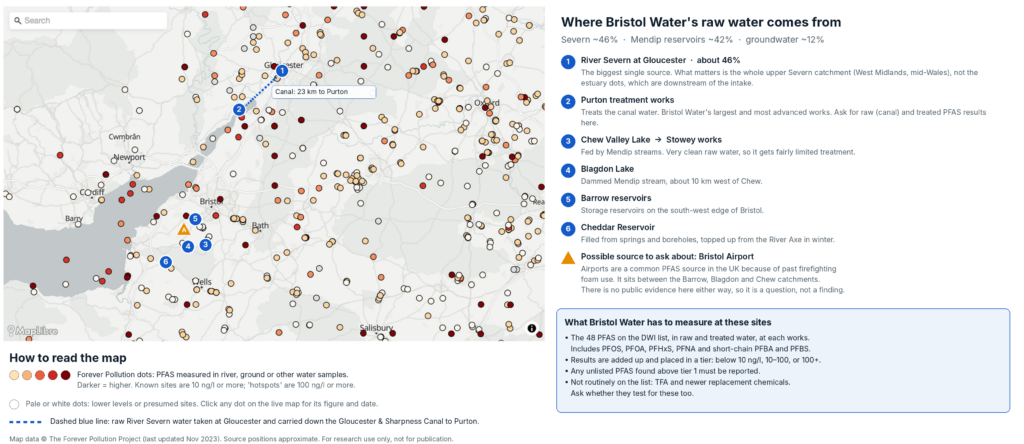
Bristol PFAS hotspots and the drinking water intake locations
The rules: guidance in England, law elsewhere
In England and Wales, PFAS in drinking water is controlled by Drinking Water Inspectorate guidance, not law. The DWI itself says there are currently no statutory standards for PFAS, and no World Health Organisation guideline value.
The DWI tier system
| Tier | PFAS level | What the company must do |
|---|---|---|
| Tier 1 | Below 0.01 µg/l | Routine monitoring and risk assessment |
| Tier 2 | 0.01 to below 0.1 µg/l | More frequent monitoring and a strategy to progressively reduce levels |
| Tier 3 | 0.1 µg/l or more | Notify the DWI and health authorities, and act to bring levels below 0.1 µg/l |
The guideline value is 0.1 µg/l for the sum of 48 named PFAS. Since 2025, the tiers also apply to raw water where no PFAS treatment is in place. Companies must report any unlisted PFAS found above tier 1.
A legal limit is promised, not delivered
The government’s first national PFAS Plan, published in February 2026, promises a consultation on a legal limit for England. As of November 2026, that consultation has not been published.
How England compares
| Country | Legal status | Limit |
|---|---|---|
| England and Wales | Guidance only | 0.1 µg/l, sum of 48 named PFAS |
| Scotland | Legal limit | 0.1 µg/l, sum of 20 PFAS (a different list) |
| EU | Legal limit, from January 2026 | Sum of all PFAS below 0.5 µg/l, plus a limit on 20 named PFAS |
| USA | Legal limits finalised in 2024 | 0.004 µg/l each for PFOA and PFOS; the EPA has since signalled extending the deadline to 2031 |
How much stricter the US is depends on which UK threshold you compare. The US limit of 0.004 µg/l applies to PFOA and PFOS individually. In England, a reduction strategy is required from 0.01 µg/l (2.5 times the US level), and immediate action only at 0.1 µg/l (25 times the US level).
The Royal Society of Chemistry has called for 10 ng/l per individual PFAS (0.01 µg/l), ten times stricter than current guidance.
How much is in our water, and the testing gaps
Treated tap water in England and Wales generally meets the DWI guidance. Raw water is a different picture: DWI data showed 278 cases where untreated drinking water sources exceeded maximum guidance levels.
The bigger issue is what is not measured.
- 48 out of thousands. Companies test for 48 named PFAS. Thousands exist, and new ones keep entering use.
- Replacement chemicals. At Thornton-Cleveleys, the Environment Agency reportedly did not test for EEA-NH4, a replacement chemical the site produces.
- Unclear scope. EIR responses often confirm results are below tier 1 without listing which PFAS were analysed.
- No routine blood monitoring. The UK has no national biomonitoring programme for PFAS. Belgium and Italy have run population testing near contaminated sites.
- Food and soil. Tap water is only one route. As Thornton-Cleveleys shows, soil and home-grown food can matter more.
The same pattern shows up beyond PFAS. When I asked Bristol Water under the EIR which pesticides it monitors in raw water, the answer was 36 across the whole company, against 266 pesticides approved for use in Great Britain, with no breakdown products on the list. You only find what you test for.
What water companies are doing, and what it costs
Every major water company in England and Wales has DWI-required PFAS work in its 2025–30 programme. These legal instruments require monitoring, risk assessment and strategies to reduce PFAS at tier 2 and tier 3 sites.
The money tells a different story.
| Figure | Amount | Source |
|---|---|---|
| Total industry investment, 2025–30 | £104bn | Ofwat final determination |
| Drinking water quality, including lead and PFAS | About £2bn | Building / Arcadis |
| Estimated cost to upgrade treatment for PFAS | Almost £20bn | UKWIR, via Chemistry World |
| Remediation of 2,900–10,200 high-risk sites in England | £31bn–£121bn | Environment Agency, via Smart Water Magazine |
On these figures, upgrading treatment for PFAS alone would cost roughly ten times what the current plan sets aside for all drinking water quality work.
Part of the reason is financial. Ofwat’s Monitoring Financial Resilience Report 2025–26 (October 2026) found six companies with gearing at or above 70%, the level Ofwat considers inconsistent with long-term resilience. When debt is high, treatment upgrades for emerging contaminants compete with debt servicing for every pound.
What actually removes PFAS: the UK research
In 2025 the DWI published bench- and pilot-scale research with Cranfield University, testing treatment methods on UK groundwater, upland and lowland surface water. Its main finding: no single method suits every PFAS, and chain length matters most.
| Method | Long-chain PFAS (PFOA, PFOS) | Short-chain PFAS (PFBA, PFBS) | Notes |
|---|---|---|---|
| Reverse osmosis / nanofiltration | Up to 99% removed | Over 80% removed | Highest removal of all methods tested |
| Ion exchange (PFAS-selective resin) | Effective | Weak, early breakthrough | Lasts longer than carbon |
| Granular activated carbon | Effective | Weak, early breakthrough | Needs frequent media changes |
| Coagulation and filtration (standard treatment) | Not effective | Not effective | Moves PFAS into sludge |
The last row matters beyond drinking water. Standard treatment can transfer PFAS into treatment sludge, which affects how that sludge can be disposed of, including spreading on farmland.
The researchers recommended pilot work on carbon, ion exchange, surface-modified clays and nanofiltration, noting these work best in combination.
Protecting your home
The same physics applies at home as at a treatment works. If PFAS is your main concern, here is how the options compare.
- Reverse osmosis (under-sink): the most complete removal, including short-chain PFAS. Membranes and pre-filters need changing on schedule.
- Carbon block filters: can reduce long-chain PFAS well, but performance varies widely and falls as the carbon fills. Look for NSF/ANSI 53 certification for PFOA/PFOS, and change cartridges on time.
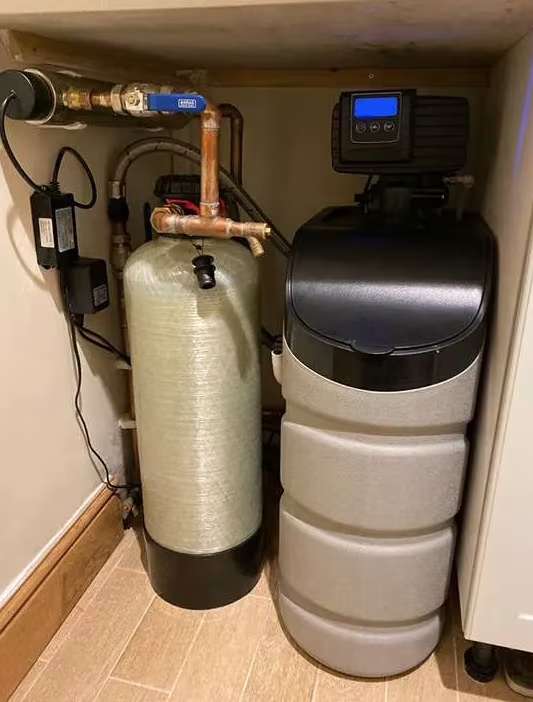
- Ion exchange: PFAS-selective resins are not equally good for all PFAS. They hold long-chain PFAS and sulfonates such as PFOS and PFHxS well, but short-chain acids such as PFBA break through first. As the resin fills, longer chains can push short chains back out. A standard water softener is a different kind of ion exchange, swapping calcium and magnesium, and is not designed to remove PFAS.
- Distillation: boiling and condensing water leaves most PFAS behind in the boiling chamber. Independent test data for home distillers is thinner than for reverse osmosis, and more volatile PFAS compounds may carry over with the steam. Ask for published lab results for PFAS, not just a general purity claim.
- Ultrafiltration: removes particles, bacteria and larger molecules, but its pores are roughly 10 to 100 times wider than a PFAS molecule. On its own it does not remove dissolved PFAS. It is mainly used as a pre-filter.
- Basic jug filters: most are designed for taste, chlorine and limescale, not PFAS.
- Whole-house systems: treat water for showering and washing too. For PFAS, drinking and cooking water is the main exposure route, so a point-of-use system is usually the priority.
Whatever you choose, an exhausted filter can perform worse than none, so maintenance matters as much as the product.
How to check your own water
Water companies must provide environmental information on request under the Environmental Information Regulations 2004 (EIR). It is free, and they must reply within 20 working days. Residents in Thornton-Cleveleys used exactly this route to get PFAS data from United Utilities.
Copy, fill in and send this to your water company’s EIR or information-request address:
Dear [Water company],
I am requesting environmental information under the Environmental Information Regulations 2004. I am a customer at [postcode].
Please provide, for the water supply zone and treatment works serving this postcode, for the last two years:
- The full list of PFAS compounds analysed, in raw and treated water.
- All results, including those below the limit of detection, with the limits used.
- The DWI tier each source and works is currently in.
- Any PFAS treatment installed at the works, and when it was commissioned.
Please send the information by email, with data in spreadsheet form where held.
Kind regards, [Name]
When the reply arrives, check three things: how many PFAS were tested, whether raw water was included, and whether any source sits in tier 2. Share what you find in our group, Curious About UK Drinking Water.
What we still don’t know
- When England will consult on a legal limit, and what it will cover.
- How much of the UK population carries elevated PFAS, since there is no national blood monitoring.
- The health effects of short-chain and replacement PFAS such as EEA-NH4.
- How many treatment works have PFAS-capable treatment, as this is not published nationally.
- What happens to PFAS concentrated in sewage sludge spread on farmland.
We will update this article as answers arrive, including our requests about Brislington Brook.
Sources
- DWI: PFAS and Forever Chemicals
- DWI Information Letter 03/2025: revised PFAS guidance
- DWI: research published in 2025
- Innovation News Network: DWI PFAS treatment study
- Innovation News Network: England moves towards a legal PFAS limit
- Environment Analyst: pressure mounts for PFAS laws
- Chemistry World: RSC calls for tighter PFAS limits (UKWIR £20bn estimate)
- Smart Water Magazine: parliamentary PFAS report
- Sustainability Magazine: PFAS clean-up costs and raw water exceedances
- ITV News: Thornton-Cleveleys blood test results
- The Chemical Engineer: UK says evidence of health risks lacking
- United Utilities EIR-559: Thornton-Cleveleys PFAS
- Leigh Day: Bentham residents
- Bristol24/7: Brislington Brook deaths linked to fire
- Speciality Chemicals Magazine: AGC consults on closure
- City of Thornton, Colorado: US EPA timeline
- Building: AMP8 priorities
- Burges Salmon: AMP8 £104bn
- DWI PR24/AMP8 overview (legal instruments)
- Ofwat, Monitoring Financial Resilience Report 2025–26 (October 2026)
- Bristol Water (South West Water), EIR response EIR26156 (May 2026)

About the Author
Nick Smith | Founder | The Water Dr. & Cellthyhomes
Nick has dedicated years to studying building biology, healthy living environments, and the impact of environmental toxins on inflammation.
Whilst regulations for UK drinking water are slow to adapt, & influenced by conflicts of interest, Nick conduct comprehensive research on global regulations & scientific literature to offer water filtration solutions that provide clean drinking water free from all harmful contaminants.