Mineral-rich, toxin-free, electrically coherent water.
After years of evaluating hundreds of water treatment technologies, we had the good fortune of finding Aurmina and for the first time we found a natural solution that aligned with our philosophical approach to water quality. Aurmina isn’t just another filter. It represents a fundamentally different paradigm in water purification, one that removes contaminants while simultaneously restructuring and remineralizing water.
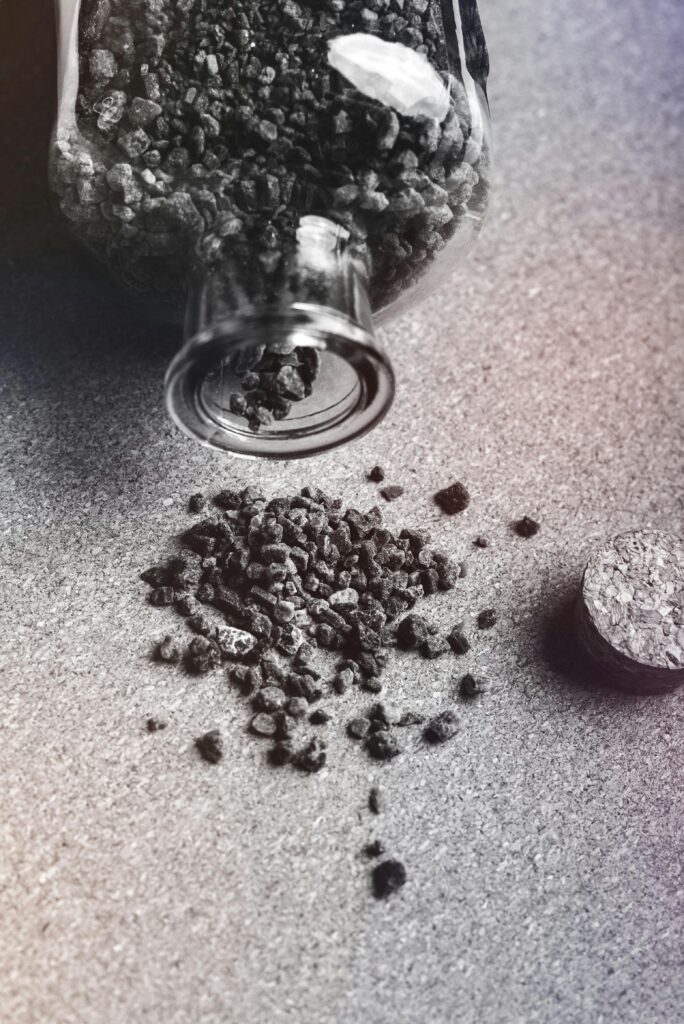
Aurmina is derived from biotite, a naturally occurring volcanic mineral also known as black mica . This isn’t new-age pseudoscience—biotite has been used for water purification for centuries, and the modern formulation has been rigorously tested by independent toxicologists .
What is Aurmina
Aurmina™ is composed of natural ionic sulfate mineral salts extracted from volcanic rock known as biotite mica vermiculite. Biotite, a silicate mineral similar to zeolites, is part of the same family of aluminosilicate minerals. Like zeolites, biotite is valued for its ability to support detoxification and purification processes, making it an ideal ingredient for water treatment.
- Purified Water: 97.5%
- Ionic Sulfated Mineral Salts: 2.5%
How Aurmina Works:
The solution contains natural ionic sulfate minerals that work through a sophisticated ion-exchange process to remove over 250 impurities from water. These bound contaminants are transformed into insoluble particles that precipitate out of solution .
The purification occurs in four stages: flocculation, agglutination, coagulation, and deposition.
Stage 1: Flocculation
The ionic sulfate minerals in Aurmina™ initiate the purification process by promoting flocculation. Charged minerals attract oppositely charged contaminants, such as heavy metals and organic impurities, causing them to clump together into visible clusters for easier removal.
Stage 2: Agglutination
During agglutination, the clusters formed in the flocculation stage combine into larger, more stable aggregates. These larger particles make the contaminants easier to isolate and remove in subsequent steps.
Stage 3: Coagulation
In the coagulation stage, the ionic sulfate minerals neutralize smaller, dissolved impurities, transforming them into insoluble particles. This step ensures even fine contaminants, including organic compounds, are captured for complete purification.
Stage 4: Deposition
In the final stage, deposition (or sedimentation), the heavier insoluble particles settle to the bottom of the container. This process separates clean water from the contaminants, leaving a purified layer of water ready for filtration or consumption.
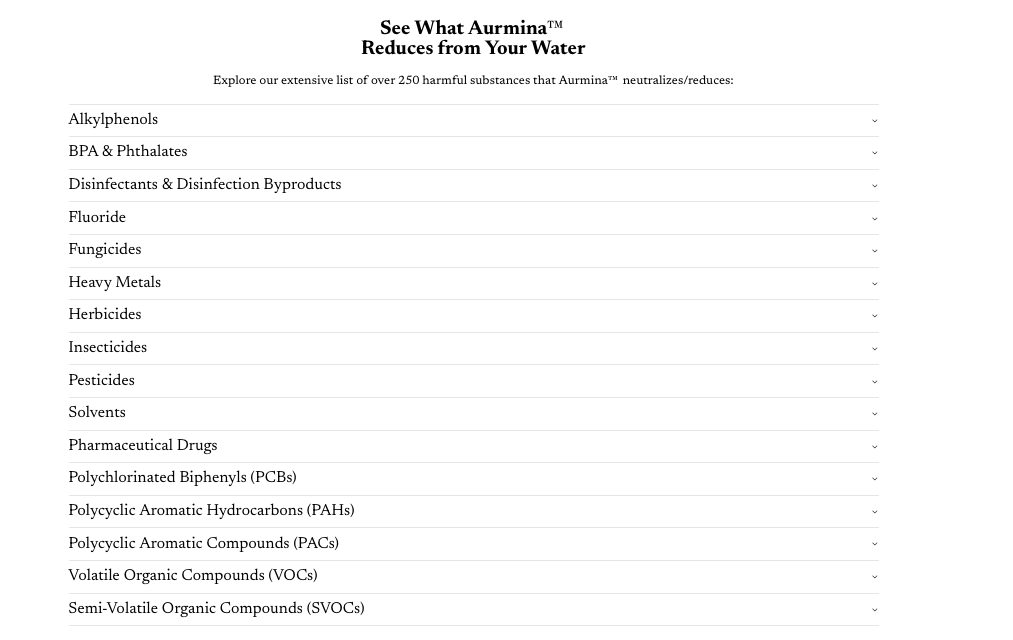
Independent laboratory testing has verified Aurmina’s ability to reduce or remove: Over 250 identified contaminants in total
Electrical coherence
What truly sets Aurmina apart from conventional filtration is what it adds not just what it removes. After binding and removing contaminants Aurmina simultaneously “structures” the water and adds a complex multi-element mineral matrix.
This idea has been quite broadly discussed across a number of terms Structure , Exclusion Zone , Hexagonal but we believe accuracy lies in the term ” coherent water ” . Dr Pierre Kory has gone to great lengths explaining about how the electrical coherence of the water is so important with regards to explaining the benefits. Ultimately resulting in a medium that shuttles energy efficiently and has an ORP and PH similar to that off traditional healing springs and restores intracellular communication …
Historical analysis has discussed broadly this “structured water” molecules organised in coherent crystalline patterns rather than chaotic arrangements
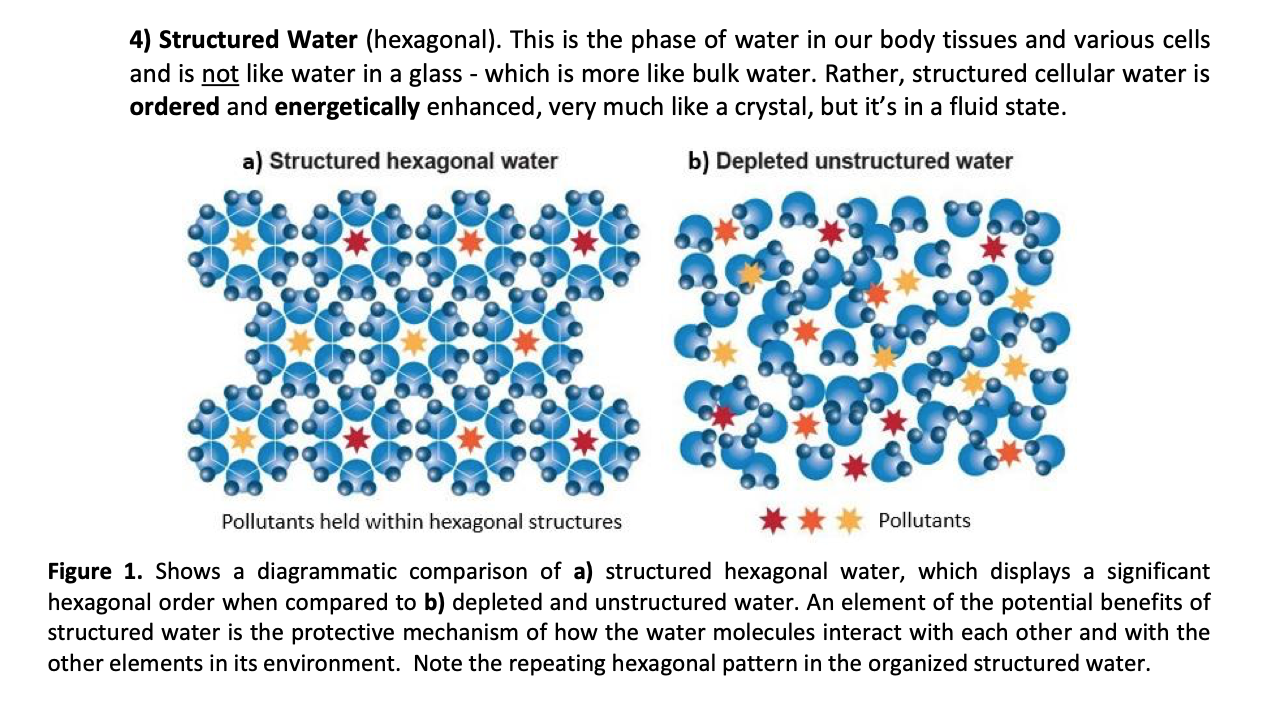
Another way to measure and identify this is through its UV spectrum absorbance. Research shows that structured water appears when the UV absorbance at 270 nm is 1 or greater. Independent lab testing shows Aurmina™ produces an absorbance value of 1.3584 at this wavelength, confirming it ability to create this medium .
Remineralization
Our mineral intake has been severely depleted over time from practises like over farming and poor irrigation water impacting the soil quality . The amount of minerals that we are getting through our food and nutrition is consequently going down . Our consumption and supplementation has also been considered and managed through a very narrow list of a dozen or so names based primarily on the fact that these minerals are easier to test and monitor ..
These common names are all well represented in Aurmina
- Iron: 792 mg/l
- Sulfur: 5800 mg/l
- Magnesium: 287 mg/l
- Potassium: 218 mg/l
- Phosphorus: 25.4 mg/l
- Calcium: 45.0 mg/l
- Manganese: 14.27 mg/l
- Zinc: 1.56 mg/l
But there are additionally up to 80 smaller trace minerals, such as alum, cerium, chromium, cobalt, copper, lanthanum, lithium, nickel, rubidium, scandium, selenium, silicon, strontium, titanium, and vanadium. Many of which re barely studied or understood as to howe they may influence and contribute to our energy production or basic physiology . They exist naturally as part of the biotite mineral complex. The result is water that resembles naturally mineralized volcanic spring water—the type humans have thrived on for millennia.
It is important to not that it is both the medium AND the fact that all the minerals in Aurmina are sulphated which is very important for their bioavailability ,absorption and bioactivity .
Why Aurmina Complements Rather Than Replaces Existing Filtration
One of the most remarkable aspects of Aurmina is its versatility it enhances and complements existing filtration systems as well as in isolation . It can easily be added to all freshwater sources from inert RO + distilled water to unfiltered tap water , it plugs the gaps for removing any contamination and delivers the minerals thats organise the water structure for bioavailability .
Batching & Dosing Aurmina: What You Need to Know
Using Aurmina takes a little planning, but once you have a system in place it becomes second nature. Dosing is straightforward: use ½ teaspoon per 4 litres for RO or distilled water, which settles in as little as 5–15 minutes, or increase up to 2 teaspoons per 4 litres for untreated tap or well water, which requires 24–48 hours for the ion-exchange process to work and contaminant sediment to fully precipitate. Because of this treatment window, Aurmina works best as a batching system rather than an on-demand filter — you’ll want at least two containers rotating at any time, so that as you empty one into your ceramic gravity filter (like a Berkey or similar), you’re refilling and starting the next batch. That secondary filtration step is essential to remove the precipitated sediment before drinking, though a Brita jug, coffee filter, or cheesecloth can also work .
Cost Economics
The upfront cost of is very competitive when you consider A 32oz bottle of Aurmina costs approximately £125 and treats up to 2000 Litres of water for a household . This equates to just 6 pence per litre comparable to or less than replacement filters for carbon systems, and dramatically less expensive than buying lower quality bottled water at £1.50 per litre.
Independent Verification
Dr. Rosenfeld a toxicologist who approached Aurmina with skepticism. His 269-page report using EPA Method 6020 with ICP-MS analysis confirmed that Aurmina removes contaminants effectively while adding only beneficial trace minerals.
The Vision: Bringing Healing Spring Water Home
Throughout human history, people have travelled to healing springs—places like Lourdes in France, Bath in England, or volcanic hot springs across Iceland and Japan—seeking waters with special properties. These waters share common characteristics: they’re mineral-rich, flowing through volcanic or mineral-dense geology, naturally structured, and free from modern contaminants.
Aurmina represents an attempt to bring those healing spring qualities into your home. It uses the same volcanic mineral processes that create natural spring water, applied to whatever water source you have available.
1. The science is sound – Independent toxicological testing confirms both safety and effectiveness
2. The results are visible – You can literally see what’s being removed from your water
3. The philosophy aligns – It doesn’t just remove contaminants; it restores water’s natural properties
4. The price is honest – No proprietary cartridges or locked-in replacement cycles
5. The versatility is practical – It works with existing systems rather than requiring you to throw everything out and start over
Water is a dynamic, structured medium that carries both information and minerals. Truly healthy water requires removing the harmful while preserving and restoring the beneficial.
mineral-rich, toxic-free, electrically coherent water that promotes health rather than merely preventing illness.
If you’re interested in learning more or incorporating Aurmina into your home water system, contact us at TheWaterDr.


About the Author
Nick Smith | Founder | The Water Dr. & Cellthyhomes
Nick has dedicated years to studying building biology, healthy living environments, and the impact of environmental toxins on inflammation.
Whilst regulations for UK drinking water are slow to adapt, & influenced by conflicts of interest, Nick conduct comprehensive research on global regulations & scientific literature to offer water filtration solutions that provide clean drinking water free from all harmful contaminants.