Restoration not filtration
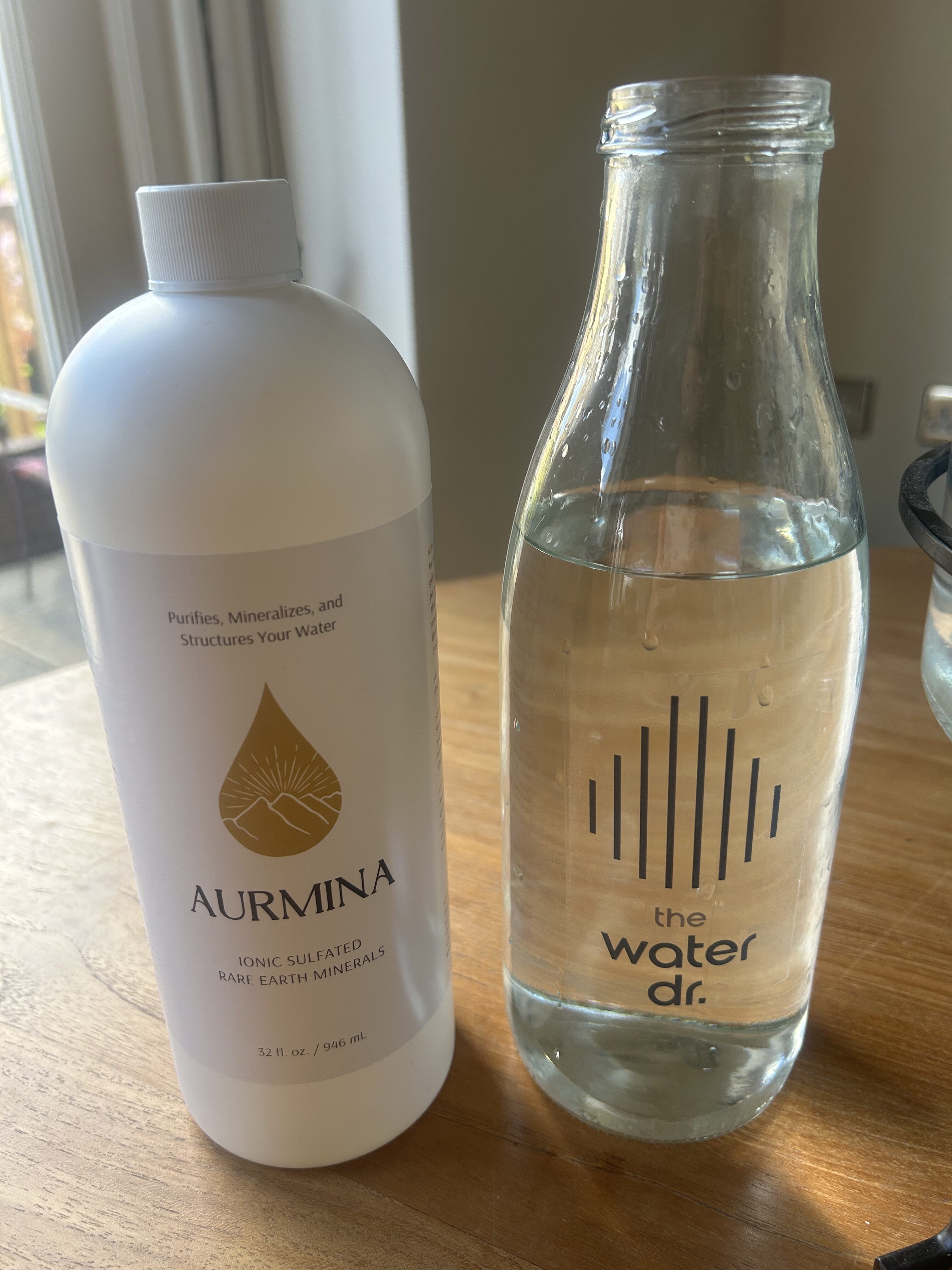
Water is often called the universal solvent — and for good reason. A water molecule is polar, carrying a slightly positive charge at one end and a slightly negative charge at the other. This polarity is what makes water so hospitable: it naturally surrounds charged particles, cradles them in solution and holds them dissolved and invisible. It is an extraordinary property. It is also the reason water becomes dangerous when the wrong things get in. Heavy metals, fluoride, pharmaceuticals, pesticides — these enter water as free, reactive ions carrying unresolved electrical charges, and water’s own chemistry welcomes them, holds them stable and makes them bioavailable. The same electrochemical hospitality that makes water life-giving is what makes contaminated water harmful. Aurmina™ works by understanding this — and using it. Its ionic sulfated minerals, drawn from volcanic rock, introduce a competing electrochemical force stronger than the bond water maintains with contaminant ions. The contaminant is outcompeted, drawn away from the water molecules holding it in solution, bound to the mineral, neutralised and precipitated out. Crucially, this process is selective by nature — not by design. The minerals that belong in healthy water already exist in ionic equilibrium; they carry no unresolved charge for Aurmina’s™ minerals to react with, so they are left entirely undisturbed. What is targeted is only what does not belong — the unstable, disruptive ionic charge of contamination. And as that contamination is drawn out, Aurmina’s™ own volcanic mineral complex simultaneously releases magnesium, potassium, calcium and up to 80 trace minerals back into the water in exactly the stable, bioavailable form that pristine spring water has always carried them. This is not purification in the conventional sense. It is restoration — water being returned, through the same electrochemical intelligence that nature has always used, to the state it was always meant to be in.
The Engine Behind the Process: Ionic Sulfated Minerals
Before understanding what Aurmina™ does to your water, it helps to understand what it is made of — and why those two specific words, ionic and sulfated, are the reason it works at all.
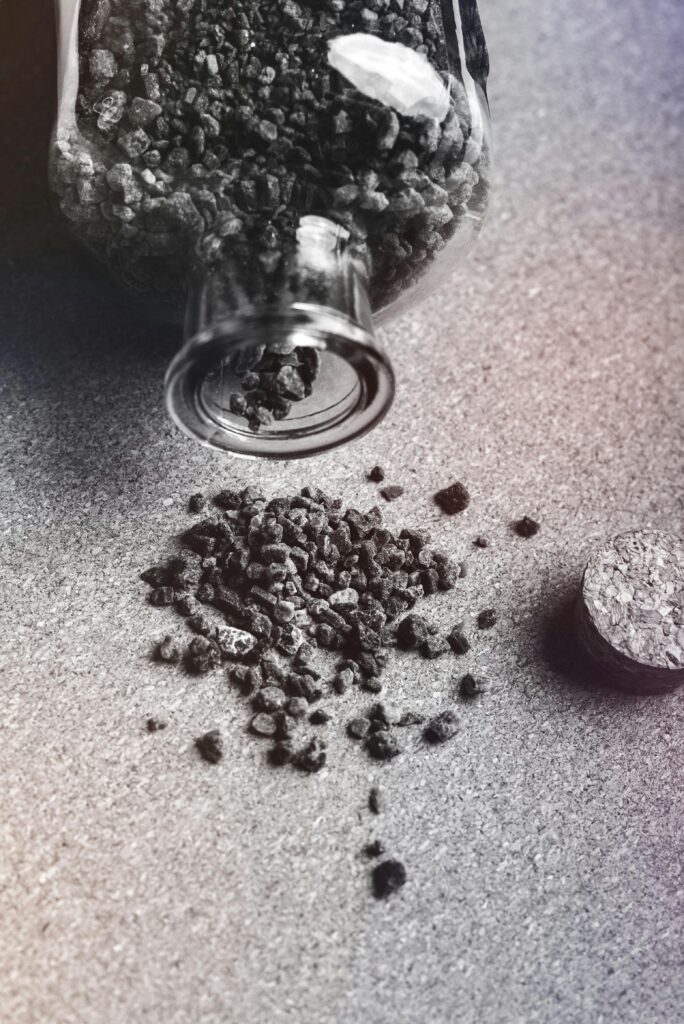
Aurmina™ contains natural mineral salts extracted from volcanic biotite mica — an ancient aluminosilicate rock formed under immense geological heat and pressure. Within that mineral complex, the active agents are ionic sulfated minerals. These are not synthetic compounds. They are not engineered resins or manufactured chemicals. They are minerals in the precise form that nature produces when volcanic rock meets water over geological time.
What Does ‘Ionic’ Mean — and Why Does It Matter?
An ion is an atom or molecule that carries an electrical charge. When a mineral is in ionic form, it has either lost or gained electrons, giving it either a positive charge (a cation) or a negative charge (an anion). This charge is everything.
Most contaminants in water — heavy metals like lead and mercury, fluoride, pharmaceutical residues, pesticides — are themselves ionically charged. They exist in water not as solid particles you could filter out, but as dissolved reactive ions, invisible and chemically active. A physical filter cannot catch what it cannot see. An ion, however, can interact with another ion of opposite charge.
Because Aurmina’s™ minerals are ionic, they carry the electrical charge necessary to seek out, attract and bind to contaminant ions directly in solution. This is not mechanical filtration. It is electrochemical interaction — the same principle that governs how minerals behave in natural springs, river sediment and the earth itself.
Ionic minerals do not wait for contaminants to pass through them. They actively reach out and bind to what does not belong
What Does ‘Sulfated’ Mean — and Why Does It Matter
Sulfated means the minerals exist as sulfate compounds — bound to the sulfate ion (SO₄²⁻). Sulfate is one of the most chemically active and versatile anions found in nature. It is abundant in volcanic rock, ocean water and healthy soils. Its significance for water purification is profound:
• Sulfate ions carry a strong negative charge, making them highly effective at attracting and binding positively charged heavy metal cations — lead, mercury, cadmium, arsenic and others that conventional filters struggle to fully address.
• The sulfate bond stabilises the mineral complex, keeping the active minerals in a soluble, reactive state in water — meaning they remain available to interact with contaminants throughout the purification process rather than simply sinking immediately.
• Sulfate compounds have a natural affinity for forming insoluble precipitates when they react with certain contaminants. This is not a side effect of Aurmina™ — it is the mechanism. When a sulfated mineral binds to a dissolved heavy metal, the resulting compound is often insoluble, meaning it falls out of solution and becomes the sediment you see at the bottom of your container.
• The sulfate matrix also supports the coagulation of organic contaminants — pesticides, herbicides, pharmaceuticals and PFAS-adjacent compounds — by disrupting the ionic stability that keeps these substances dissolved in water.
Sulfate is nature’s precipitating agent. It transforms dissolved toxins into something the water can release
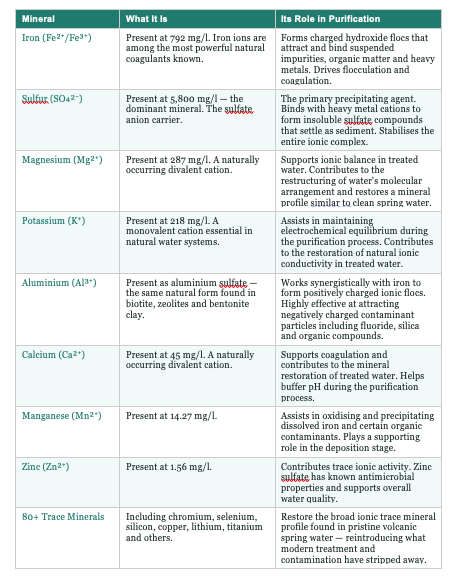
The Mineral Profile: What Is Actually in Aurmina™?
Why the Combination Matters More Than Any Single Mineral
No single mineral in this list does everything on its own. The reason Aurmina™ is able to address over 250 contaminants simultaneously — rather than one or two like a conventional filter — is because the ionic sulfated mineral complex works as an interconnected system.
Iron drives flocculation. Sulfate drives precipitation. Aluminium amplifies coagulation. Magnesium, potassium and calcium restore ionic balance. The trace minerals return what was lost. Each plays its role in a cascade that mirrors exactly what happens when rainwater filters through layers of volcanic rock over hundreds of years — condensed into a single teaspoon of solution.
This is not a formula designed in a laboratory. It is a formula refined by the earth itself over geological time.
The Four Stages of Natural Clarification
With that mineral foundation in place, the four-stage clarification process becomes easier to understand. Each stage flows naturally from the ionic and sulfated properties described above.
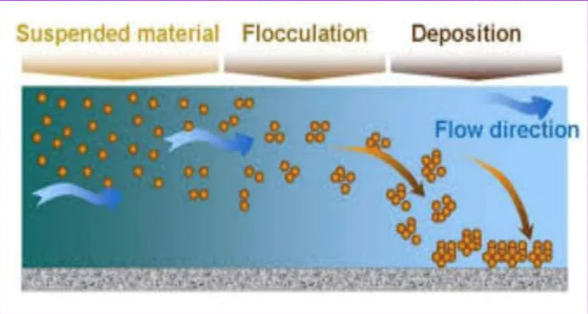
Stage 1 — Flocculation: The Gathering
Think of this as a kind of magnetism. Aurmina’s™ charged minerals carry an opposite electrical charge to many of the contaminants dissolved in your water — heavy metals, organic impurities, residual pharmaceuticals. Opposites attract. These particles begin to draw together, forming small visible clusters.
The water is not being forced. It is being invited to release what does not belong.
Stage 2 — Agglutination: The Bonding
The small clusters from the flocculation stage now combine into larger, more stable aggregates. Agglutination is the binding together of these particles into forms that are heavy enough and stable enough to be isolated and removed. The contaminants are no longer free-floating and reactive — they are bound together, neutralised and beginning their journey out of your water.
Stage 3 — Coagulation: The Transformation
Coagulation captures the finer dissolved impurities that escaped the earlier stages. Aurmina’s™ minerals neutralise these smaller particles, transforming soluble, bioavailable contaminants into insoluble compounds. In plain terms: substances that your body could previously absorb are converted into a form your body simply cannot interact with.
This is not filtration. This is chemistry — the same chemistry nature has used for millennia.
Stage 4 — Deposition: The Settling
The final stage is the one you can see. Heavier insoluble particles, now neutralised and stable, sink to the bottom of your container. This is deposition — or precipitation — and it is the visible proof that Aurmina™ has done its work.
Above the sediment line sits something extraordinary: water that has been clarified, restructured, and returned to a state closer to how it exists in untouched natural springs.
Why Is There SeSediment at the Bottom of My Container?
The residue you see is the final stage of Aurmina’s™ natural clarification process — deposition. During this stage, dissolved solids and impurities in the water bind together, become neutralised, and settle as visible sediment at the bottom of the container.
This material is not in a bioavailable form. When contaminants precipitate, they are:
• Pulled out of solution — no longer dissolved as reactive ions
• Stabilised and bound into insoluble complexes
• No longer able to interact with the body in the way soluble substances can
In this bound, insoluble form, the particles behave more like inert mineral sediment — they simply pass through the digestive system without being absorbed.
If you prefer not to consume the settled material at all, it can be easily removed using a water filter, cheesecloth, coffee filter, or any common gravity-style filtration system.
What About Particulates or Clumps in the Bottle?
Any clumping or particulates you may notice in your Aurmina™ bottle are natural mineral precipitates. They form due to the high mineral salt content and can appear when the solution is exposed to shifts in temperature, oxygen, altitude, or even harmless airborne spores during storage or transport.
This is the same natural phenomenon you might recognise in high-quality apple cider vinegar — where sediment or organic formations can develop over time. These are purely aesthetic. They do not affect the product’s safety, effectiveness, or quality in any way.
If you prefer, simply strain the solution using a coffee filter or cheesecloth. Or use it as-is. Either way, Aurmina™ is working exactly as it should.
The Ion Exchange: How Aurmina™ Targets Contaminants
At the heart of Aurmina’s™ process is ion exchange — a mechanism nature uses constantly in soils, rivers and mineral springs. Aurmina’s™ natural ionic sulfated minerals drive this exchange in two key ways:
Attracting and Replacing Harmful Ions
The charged minerals selectively bind with and replace harmful contaminants — including heavy metals, pesticides, herbicides, pharmaceuticals, BPA, fluoride and VOCs. This exchange removes impurities while simultaneously stabilising the water’s ionic balance.
Forming Insoluble Compounds
The reaction between Aurmina’s™ ionic minerals and contaminants transforms harmful substances into insoluble particles that are easy to remove. What was once dissolved and reactive becomes stable and inert.
Aurmina™ addresses a broad range of harmful substances, including:
• Heavy Metals
• Pesticides & Insecticides
• Herbicides
• Pharmaceuticals
• BPA & Phthalates
• Disinfectants & Disinfection Byproducts
• Fluoride
• VOCs (Volatile Organic Compounds) and SVOCs
• PCBs, PAHs, and PACs
Why Aurmina™ Is Different From Filters You Can Buy
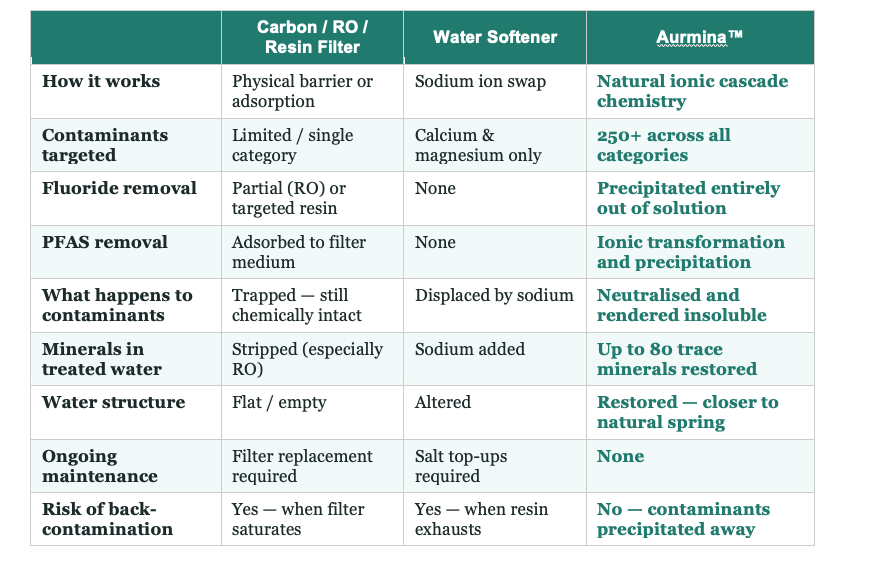
You may already own a water softener, a reverse osmosis system, or a filter designed to remove fluoride or PFAS. These are useful tools — but they work in a fundamentally different way to Aurmina™. Understanding that difference matters.
Conventional Filters: Catch and Hold
Most household water treatment systems — activated carbon filters, reverse osmosis membranes, ion exchange resins and water softeners — are catch and hold systems. They intercept contaminants and trap them. The contaminant is removed from your water, but it is not destroyed or neutralised. It still exists, chemically intact, inside the filter medium.
This matters for several reasons:
• A carbon filter adsorbs contaminants onto its surface. When the carbon saturates — and it will — those contaminants can begin to leach back into your water. The filter becomes a liability if not replaced on schedule.
• A reverse osmosis membrane physically blocks particles under pressure. It is highly effective, but it strips everything — including the beneficial minerals your body needs — leaving water that is chemically empty, slightly acidic, and structurally flat. It also wastes three to four litres of water for every litre it produces.
• A water softener performs a targeted ion swap — removing calcium and magnesium by replacing them with sodium. It softens water but adds sodium, does nothing for fluoride, PFAS, pharmaceuticals or heavy metals, and requires regular salt top-ups to regenerate the resin.
• PFAS-specific and fluoride resins are highly targeted — they capture one or two contaminant types — but again, those contaminants remain reactive and intact inside the resin until the resin is disposed of.
In every conventional system, the contaminant is moved — not transformed.
Aurmina™: Neutralise and Precipitate
Aurmina™ works on an entirely different principle. Rather than catching contaminants and holding them in a filter medium, it chemically transforms them — converting reactive, soluble, bioavailable substances into insoluble, inert compounds that settle harmlessly to the bottom of your container and can simply be poured away.
The contaminant is not relocated. It is neutralised. There is no saturating filter to replace, no resin exhausting over time, no membrane to maintain. And crucially — unlike reverse osmosis — Aurmina™ does not strip your water bare. It adds back up to 80 naturally occurring trace minerals, restoring the ionic balance that clean spring water has always carried.
On fluoride specifically: independent laboratory testing confirms that Aurmina™ reduces sodium fluoride below the detection limit of EPA Method 340.2 — not by blocking it with a membrane, but by precipitating it entirely out of solution. On PFAS and the broader family of persistent organic contaminants, Aurmina’s™ ionic cascade works across a spectrum of over 250 substances simultaneously — something no single-target resin or filter can match
The simplest way to understand it:
A conventional filter takes a contaminant out of your water and puts it somewhere else — inside the filter, where it waits. Aurmina™ takes a contaminant and changes what it is — from something reactive and harmful into something inert and harmless that settles to the bottom and is gone.
One system manages contamination. The other resolves it.
Water wants to be clean
The sediment at the bottom of your container is not a problem. It is evidence.
It is evidence that the water you were drinking before contained substances that have now been drawn out, neutralised and separated. It is evidence that the process is working. And it is evidence of something more fundamental: that water, given the right conditions, moves naturally toward clarity.
Aurmina™ does not force water to be something it is not. It provides the mineral intelligence — drawn directly from volcanic rock — that water needs to shed contamination and return to the state it has always been trying to reach.
Clean, structured, alive. The way water was always meant to be.
If you would like to learn more please contact me directly or book a free consultation via the link below !
https://thewaterdr.com/contact/
Pierre Kory’s Medical Musings — pierrekorymedicalmusings.com please visit for a far better explanation of what I have tried to consolidate !

About the Author
Nick Smith | Founder | The Water Dr. & Cellthyhomes
Nick has dedicated years to studying building biology, healthy living environments, and the impact of environmental toxins on inflammation.
Whilst regulations for UK drinking water are slow to adapt, & influenced by conflicts of interest, Nick conduct comprehensive research on global regulations & scientific literature to offer water filtration solutions that provide clean drinking water free from all harmful contaminants.