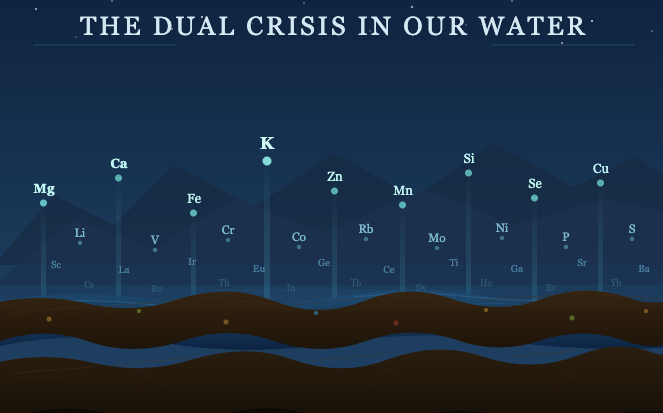
Starved and Poisoned: The Dual Crisis in Our Water
Water without minerals is biologically inert. Minerals without water are biologically inactive. The two only become life-sustaining when they exist together — ionically, electrically, in the precise relationship that natural spring water has always embodied.
Modern water treatment was designed to make water safe. But in trying to solve one problem, it created another. The processes that chlorinate, filter and distribute water have progressively stripped the mineral architecture that human biology evolved to depend on.
Research across multiple disciplines confirms that micronutrient deficiencies affect more than two billion people globally. The conventional view focuses on iron, zinc, iodine and selenium — but dozens of others, including molybdenum, vanadium, manganese, lithium, chromium and cobalt, remain almost entirely unstudied in the context of deficiency, yet are essential at a cellular level.
At the same time, heavy metal contamination is rising — lead from aged pipes, mercury from industrial discharge, arsenic from agricultural runoff, cadmium from contaminated soils. Studies find associations between trace mineral deficiency combined with heavy metal excess and Alzheimer’s disease, autism spectrum disorders, cardiovascular disease, neurological impairment, immune dysfunction and accelerated cellular ageing.
The body is not simply lacking minerals. It is simultaneously starved of what it needs and burdened with what it cannot use. Aurmina™ addresses both sides of that equation.
What Modern Treatment Does to Your Water
Rainwater descending through fractured rock acquires a full spectrum of dissolved ionic minerals — calcium, magnesium, potassium, bicarbonate and dozens of trace elements. This is what water was always supposed to contain. By the time it reaches your tap via chlorination, pH adjustment and pipe transit, the broader ionic architecture, trace mineral spectrum, bicarbonate buffering capacity and redox coherence are largely gone.
Water does not hydrate by volume alone; it hydrates by electrochemistry. Demineralised water must acquire electrolytes by drawing from the body’s own reserves, causing increased diuresis and accelerated loss of sodium, potassium, calcium and magnesium.
No natural drinking water source on Earth is mineral-free. Human physiology evolved on mineralised water — not a chemically stripped solvent.
The mineral black hole
Modern nutrition science discusses fourteen minerals. Seven are classified as major essential — calcium, phosphorus, magnesium, sodium, potassium, chloride, sulfur. Seven are classified as trace — iron, zinc, iodine, selenium, copper, manganese, fluoride. These fourteen have become what might be called the celebrity minerals: endlessly studied, endlessly supplemented, endlessly referenced.
But in prehistoric soils there were likely one hundred minerals that humans consumed regularly through food and water. Current estimates suggest soils now carry somewhere between seventy and ninety. Nutrition science discusses fourteen. The remaining fifty to eighty — vanadium, molybdenum, germanium, europium, iridium, cerium, lanthanum, rubidium, scandium and dozens of others with names most people have never encountered — are almost entirely absent from the scientific literature on human health.
This is not because they are unimportant. It is because the technology to measure them accurately at the concentrations found in biological systems only became available in 1990. Before that, the instruments did not exist. What is extraordinary — and troubling — is that when that measurement technology arrived, the field of mineral science did not reinvigorate itself. The new tools were never systematically applied to explore what had previously been unmeasurable. The black hole simply remained.
Each time one of these rare earth or ultra-trace elements has been studied in isolation — in plants, in livestock, in microbes — biological significance has been found. Every single one. The question of what the combined absence of fifty unmeasured minerals does to human health over decades remains, in the most literal scientific sense, unanswered. It has never been asked with the rigour it deserves.
What’s in Aurmina?
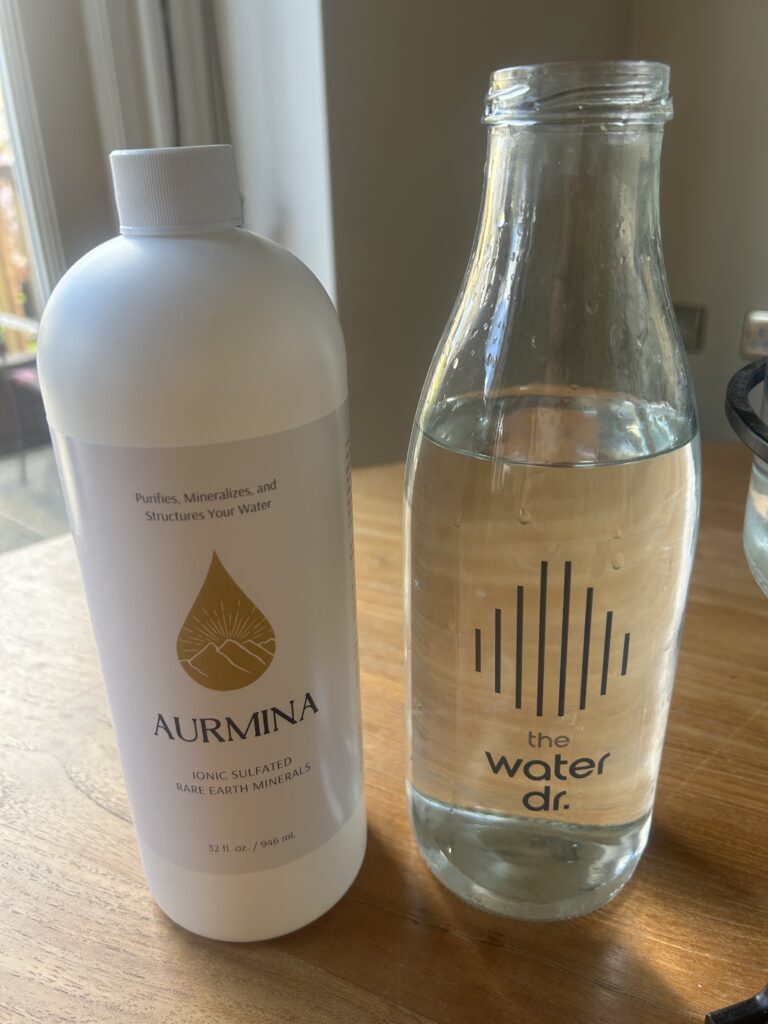
Aurmina™ is composed of natural ionic sulfate mineral salts extracted from volcanic rock known as biotite mica vermiculite. Biotite, a silicate mineral similar to zeolites, is part of the same family of aluminosilicate minerals. Like zeolites, biotite is valued for its ability to support detoxification and purification processes, making it an ideal ingredient for water treatment.
Purified Water: 97.5%
Ionic Sulfate Mineral Salts: 2.5%
Approximately it contains the following minerals:
Iron: 792 mg/l
Sulfur: 5800 mg/l
Magnesium: 287 mg/l
Potassium: 218 mg/l
Phosphorus: 25.4 mg/l
Calcium: 45.0 mg/l
Manganese: 14.27 mg/l
Zinc: 1.56 mg/l
Additionally, Aurmina™ includes up to 80 trace minerals, such as alum, cerium, chromium, cobalt, copper, lanthanum, lithium, nickel, rubidium, scandium, selenium, silicon, strontium, titanium, and vanadium. Note: As a natural substance, the mineral composition can vary slightly.
The Engine Life Inherited: Iron, Sulfur, Aluminium and Water
To understand why Aurmina™ remineralises so differently, it is necessary to understand the planetary chemistry from which it derives — what independent researchers describe as the Iron–Sulfur–Aluminium–Water system (ISAW): a planetary-scale electrochemical engine operating in Earth’s crust for billions of years, and the underlying architecture through which geology prepared the energetic and material conditions that life inherited.
• Iron — governs electron movement, cycling between oxidation states to keep energy in motion. Every living cell depends on this controlled electron movement, coupled to proton gradients, to power respiration and metabolism.
• Sulfur — mediates proton activity and renews the cycle. Delivered as sulfate in slightly acidic rainwater, it weathers iron-rich biotite into vermiculite, reopening mineral surfaces and restoring reactivity for continued charge transfer.
• Aluminium — provides the stable aluminosilicate scaffold within which iron–sulfur chemistry occurs without the system collapsing. Its persistent negative charge organises surrounding ions so energy differences accumulate rather than dissipate.
• Water — carries the entire cycle forward. Rainwater confined in fractured rock for decades or centuries gradually acquires organised charge distributions, arriving in living systems as an electrochemically conditioned medium carrying the full ionic mineral spectrum of the geology it passed through.
Life did not invent this energetic logic. It inherited it. The human body is designed to run on water that has spent years inside this chemistry.
In 1977, after twenty years of solitary experimentation, Japanese engineer Asao Shimanishi isolated a functioning phase of the ISAW planetary circuit and made it available in a bottle. Working alone with rock, heat, water, sulfur and time, he sought to produce a solution carrying a mineral spectrum resembling the elemental environment present when life first emerged.
Sulfur chemistry became central to his process. Sulfur-based reactions converted minerals into water-soluble sulfate forms while causing undesirable metals to precipitate and filter out. The resulting extract — Themarox, or Rock Extract — contained a broad spectrum of trace minerals from the original mica structure, all as sulfate salts, allowing them to dissolve fully in water as active ionic species rather than precipitating out.
The extract purified water by binding contaminants and causing them to precipitate, while simultaneously releasing minerals into solution. In a famous demonstration, Shimanishi’s minerals clarified a polluted brackish pond at a Tokyo Shinto shrine within four hours. He was filmed drinking the treated water from a glass mug lowered in on a rope.
Aurmina™ is the direct descendant of Shimanishi’s Themarox — the same volcanic mineral complex, the same ISAW chemistry, the same sulfated ionic mineral spectrum, now refined to modern standards.
Why Sulfated Ionic Is Not the Same as Simply Ionic
Most mineral supplements claim to be ionic. Fewer are sulfated. The distinction is the reason Aurmina™ stands apart from even the best competitors.
Ionic means bioavailable. Sulfated means coordinated.
Ionic minerals carry an electrical charge allowing direct interaction with biological systems — crossing cell membranes, supporting enzyme reactions and electrochemical gradients. Ionicity is the minimum requirement for bioavailability. Sulfation adds a second critical layer:
• Redox activity — Sulfate ions (SO₄²⁻) participate in proton-coupled redox reactions — the same reactions driving the ISAW system. A sulfated mineral in water is electrochemically active, influencing oxidation-reduction potential the way natural spring water does.
• Coordinated release — Minerals in the sulfated complex are held in an organised matrix, releasing progressively as chemistry interacts with water — mirroring the slow geological release from weathering rock rather than an immediate ionic flood.
• Precipitation selectivity — Sulfate forms insoluble compounds with heavy metal cations, precipitating them out while leaving beneficial mineral ions in solution. No other remineralisation approach simultaneously removes contaminants and restores minerals.
Being ionic is necessary. Being sulfated is what makes the difference between a mineral supplement and a restoration of Earth’s own chemistry.
Why Breadth Across the Periodic Table Is the Point
The critical question is not how many minerals are present, but whether their breadth and form matches what the human body evolved requiring. The body runs on a complex ionic ecosystem spanning dozens of elements: magnesium for over 300 enzymatic reactions, potassium for cellular voltage, iron for oxygen transport, zinc for immune function, selenium for antioxidant enzyme systems, chromium for glucose metabolism, manganese for bone formation, copper for connective tissue, lithium for neurological stability, silicon for collagen synthesis, vanadium for insulin sensitivity, molybdenum for detoxification enzymes — and beyond these, dozens of rare earth and trace elements whose biological roles remain largely unmeasured, present in volcanic spring water and absent from every narrow-spectrum supplement on the market.
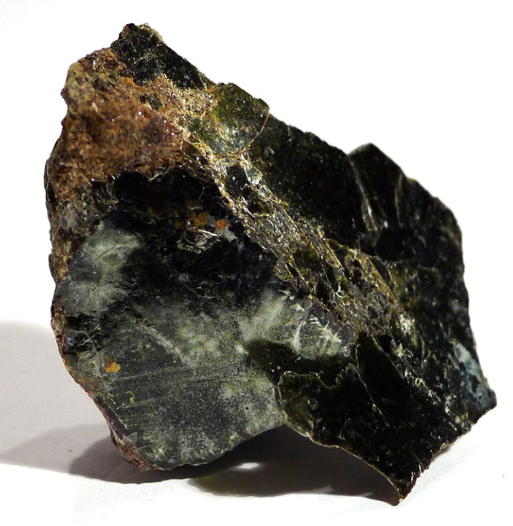
Aurmina™ derives from biotite mica — a geological archive of Earth’s mineral chemistry formed under immense heat and pressure, carrying within its layered aluminosilicate structure the full complement of minerals that circulating water has absorbed and distributed through the ISAW cycle for billions of years. It does not add a handful of minerals. It releases, in ionic sulfated form, the broad-spectrum mineral intelligence that the earth itself has always used to sustain life.
Pierre Kory’s Medical Musings — pierrekorymedicalmusings.com please visit for a far better explanation of what I have tried to consolidate !
to learn more or for further questions please reach out and book free consultation ..

About the Author
Nick Smith | Founder | The Water Dr. & Cellthyhomes
Nick has dedicated years to studying building biology, healthy living environments, and the impact of environmental toxins on inflammation.
Whilst regulations for UK drinking water are slow to adapt, & influenced by conflicts of interest, Nick conduct comprehensive research on global regulations & scientific literature to offer water filtration solutions that provide clean drinking water free from all harmful contaminants.